 Azərbaycanca (AZ)
 Deutsch (DE)
 English (US)
 Қазақша (KZ)
 Lietuva (LT)
 සිංහල (LK)
 Türkçe (TR)
 O'zbekcha (UZ)
 中國人 (CN)
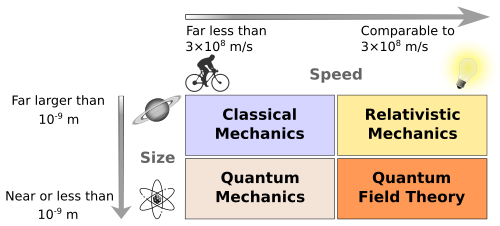
Modern physics is a branch of physics that developed in the early 20th century and onward or branches greatly influenced by early 20th century physics. Notable branches of modern physics include quantum mechanics, special relativity, and general relativity.
Classical physics is typically concerned with everyday conditions: speeds are much lower than the speed of light, sizes are much greater than that of atoms, and energies are relatively small. Modern physics, however, is concerned with more extreme conditions, such as high velocities that are comparable to the speed of light (special relativity), small distances comparable to the atomic radius (quantum mechanics), and very high energies (relativity). In general, quantum and relativistic effects are believed to exist across all scales, although these effects may be very small at human scale. While quantum mechanics is compatible with special relativity (See: Relativistic quantum mechanics), one of the unsolved problems in physics is the unification of quantum mechanics and general relativity, which the Standard Model of particle physics currently cannot account for.
Modern physics is an effort to understand the underlying processes of the interactions of matter using the tools of science and engineering. In a literal sense, the term modern physics means up-to-date physics. In this sense, a significant portion of so-called classical physics is modern. However, since roughly 1890, new discoveries have caused significant paradigm shifts: especially the advent of quantum mechanics (QM) and relativity (ER). Physics that incorporates elements of either QM or ER (or both) is said to be modern physics. It is in this latter sense that the term is generally used.
Modern physics is often encountered when dealing with extreme conditions. Quantum mechanical effects tend to appear when dealing with "lows" (low temperatures, small distances), while relativistic effects tend to appear when dealing with "highs" (high velocities, large distances), the "middles" being classical behavior. For example, when analyzing the behavior of a gas at room temperature, most phenomena will involve the (classical) Maxwell–Boltzmann distribution. However, near absolute zero, the Maxwell–Boltzmann distribution fails to account for the observed behavior of the gas, and the (modern) Fermi–Dirac or Bose–Einstein distributions have to be used instead.
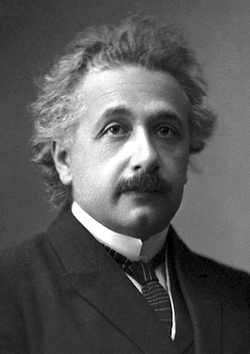
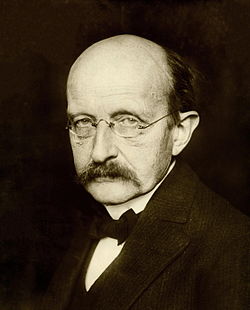
Very often, it is possible to find – or "retrieve" – the classical behavior from the modern description by analyzing the modern description at low speeds and large distances (by taking a limit, or by making an approximation). When doing so, the result is called the classical limit.
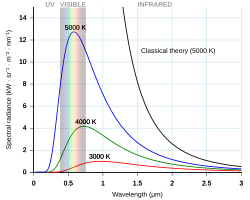
Hallmark experiments
These are generally considered to be experiments regarded leading to the foundation of modern physics:
- Black-body radiation
- Cathode ray experiments
- Compton effect
- Davisson–Germer experiment
- Eötvös experiment
- Franck–Hertz experiment
- Geiger–Marsden experiment (also called Rutherford's experiment)
- Eddington experiment
- Michelson–Morley experiment
- Photoelectric effect
- Discovery of radioactivity
- Oil drop experiment
- Stern–Gerlach experiment
- Stark effect
- Zeeman effect
See also

- History of physics
- Classical physics
- Distinction between classical and modern physics
- Quantum mechanics
- Theory of relativity
- Quantum field theory
- Unified field theory
- Nuclear Fission
wikipedia, wiki, encyclopedia, book, article, read, free download, Information about modern physics. What is modern physics? What does modern physics mean?