Azərbaycanca (AZ) Azərbaycanca (AZ)Deutsch (DE) Deutsch (DE)English (US) English (US)Қазақша (KZ) Қазақша (KZ)Lietuva (LT) Lietuva (LT)සිංහල (LK) සිංහල (LK)Türkçe (TR) Türkçe (TR)O'zbekcha (UZ) O'zbekcha (UZ)中國人 (CN) 中國人 (CN)
Support
Free Download and Information Platform
  • Wikipedia

All definitions tacitly require the homogeneous relation R {\displaystyle R} be transitive: for all a , b , c , {\displaystyle a,b,c,} if a R b {\displaystyle a

Prewellordering

  • HomePage
  • Wikipedia
  • Prewellordering
Transitive binary relations
  • v
  • t
  • e
Symmetric Antisymmetric Connected Well-founded Has joins Has meets Reflexive Irreflexive Asymmetric
Total,
Semiconnex
Anti-
reflexive
Equivalence relation Green tickY ✗ ✗ ✗ ✗ ✗ Green tickY ✗ ✗
Preorder (Quasiorder) ✗ ✗ ✗ ✗ ✗ ✗ Green tickY ✗ ✗
Partial order ✗ Green tickY ✗ ✗ ✗ ✗ Green tickY ✗ ✗
Total preorder ✗ ✗ Green tickY ✗ ✗ ✗ Green tickY ✗ ✗
Total order ✗ Green tickY Green tickY ✗ ✗ ✗ Green tickY ✗ ✗
Prewellordering ✗ ✗ Green tickY Green tickY ✗ ✗ Green tickY ✗ ✗
Well-quasi-ordering ✗ ✗ ✗ Green tickY ✗ ✗ Green tickY ✗ ✗
Well-ordering ✗ Green tickY Green tickY Green tickY ✗ ✗ Green tickY ✗ ✗
Lattice ✗ Green tickY ✗ ✗ Green tickY Green tickY Green tickY ✗ ✗
Join-semilattice ✗ Green tickY ✗ ✗ Green tickY ✗ Green tickY ✗ ✗
Meet-semilattice ✗ Green tickY ✗ ✗ ✗ Green tickY Green tickY ✗ ✗
Strict partial order ✗ Green tickY ✗ ✗ ✗ ✗ ✗ Green tickY Green tickY
Strict weak order ✗ Green tickY ✗ ✗ ✗ ✗ ✗ Green tickY Green tickY
Strict total order ✗ Green tickY Green tickY ✗ ✗ ✗ ✗ Green tickY Green tickY
Symmetric Antisymmetric Connected Well-founded Has joins Has meets Reflexive Irreflexive Asymmetric
Definitions,
for all a , b {\displaystyle a,b} {\displaystyle a,b} and S ≠ ∅ : {\displaystyle S\neq \varnothing :} {\displaystyle S\neq \varnothing :}
a R b ⇒ b R a {\displaystyle {\begin{aligned}&aRb\\\Rightarrow {}&bRa\end{aligned}}} {\displaystyle {\begin{aligned}&aRb\\\Rightarrow {}&bRa\end{aligned}}} a R b  and  b R a ⇒ a = b {\displaystyle {\begin{aligned}aRb{\text{ and }}&bRa\\\Rightarrow a={}&b\end{aligned}}} {\displaystyle {\begin{aligned}aRb{\text{ and }}&bRa\\\Rightarrow a={}&b\end{aligned}}} a ≠ b ⇒ a R b  or  b R a {\displaystyle {\begin{aligned}a\neq {}&b\Rightarrow \\aRb{\text{ or }}&bRa\end{aligned}}} {\displaystyle {\begin{aligned}a\neq {}&b\Rightarrow \\aRb{\text{ or }}&bRa\end{aligned}}} min S exists {\displaystyle {\begin{aligned}\min S\\{\text{exists}}\end{aligned}}} {\displaystyle {\begin{aligned}\min S\\{\text{exists}}\end{aligned}}} a ∨ b exists {\displaystyle {\begin{aligned}a\vee b\\{\text{exists}}\end{aligned}}} {\displaystyle {\begin{aligned}a\vee b\\{\text{exists}}\end{aligned}}} a ∧ b exists {\displaystyle {\begin{aligned}a\wedge b\\{\text{exists}}\end{aligned}}} {\displaystyle {\begin{aligned}a\wedge b\\{\text{exists}}\end{aligned}}} a R a {\displaystyle aRa} {\displaystyle aRa} not  a R a {\displaystyle {\text{not }}aRa} {\displaystyle {\text{not }}aRa} a R b ⇒ not  b R a {\displaystyle {\begin{aligned}aRb\Rightarrow \\{\text{not }}bRa\end{aligned}}} {\displaystyle {\begin{aligned}aRb\Rightarrow \\{\text{not }}bRa\end{aligned}}}
Green tickY indicates that the column's property is always true for the row's term (at the very left), while ✗ indicates that the property is not guaranteed
in general (it might, or might not, hold). For example, that every equivalence relation is symmetric, but not necessarily antisymmetric,
is indicated by Green tickY in the "Symmetric" column and ✗ in the "Antisymmetric" column, respectively.

All definitions tacitly require the homogeneous relation R {\displaystyle R} {\displaystyle R} be transitive: for all a , b , c , {\displaystyle a,b,c,} {\displaystyle a,b,c,} if a R b {\displaystyle aRb} {\displaystyle aRb} and b R c {\displaystyle bRc} {\displaystyle bRc} then a R c . {\displaystyle aRc.} {\displaystyle aRc.}
A term's definition may require additional properties that are not listed in this table.

In set theory, a prewellordering on a set X {\displaystyle X} {\displaystyle X} is a preorder ≤ {\displaystyle \leq } {\displaystyle \leq } on X {\displaystyle X} {\displaystyle X} (a transitive and reflexive relation on X {\displaystyle X} {\displaystyle X}) that is strongly connected (meaning that any two points are comparable) and well-founded in the sense that the induced relation x < y {\displaystyle x {\displaystyle x<y} defined by x ≤ y  and  y ≰ x {\displaystyle x\leq y{\text{ and }}y\nleq x} {\displaystyle x\leq y{\text{ and }}y\nleq x} is a well-founded relation.

Contents

Prewellordering on a set

A prewellordering on a set X {\displaystyle X}   is a homogeneous binary relation ≤ {\displaystyle \,\leq \,}   on X {\displaystyle X}   that satisfies the following conditions:

  1. Reflexivity: x ≤ x {\displaystyle x\leq x}   for all x ∈ X . {\displaystyle x\in X.}  
  2. Transitivity: if x < y {\displaystyle x   and y < z {\displaystyle y   then x < z {\displaystyle x   for all x , y , z ∈ X . {\displaystyle x,y,z\in X.}  
  3. Total/Strongly connected: x ≤ y {\displaystyle x\leq y}   or y ≤ x {\displaystyle y\leq x}   for all x , y ∈ X . {\displaystyle x,y\in X.}  
  4. for every non-empty subset S ⊆ X , {\displaystyle S\subseteq X,}   there exists some m ∈ S {\displaystyle m\in S}   such that m ≤ s {\displaystyle m\leq s}   for all s ∈ S . {\displaystyle s\in S.}  
    • This condition is equivalent to the induced strict preorder x < y {\displaystyle x   defined by x ≤ y {\displaystyle x\leq y}   and y ≰ x {\displaystyle y\nleq x}   being a well-founded relation.

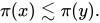
A homogeneous binary relation ≤ {\displaystyle \,\leq \,}   on X {\displaystyle X}   is a prewellordering if and only if there exists a surjection π : X → Y {\displaystyle \pi :X\to Y}   into a well-ordered set ( Y , ≲ ) {\displaystyle (Y,\lesssim )}   such that for all x , y ∈ X , {\displaystyle x,y\in X,}   x ≤ y {\textstyle x\leq y}   if and only if π ( x ) ≲ π ( y ) . {\displaystyle \pi (x)\lesssim \pi (y).}  

Examples

 
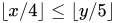
Hasse diagram of the prewellordering ⌊ x / 4 ⌋ ≤ ⌊ y / 5 ⌋ {\displaystyle \lfloor x/4\rfloor \leq \lfloor y/5\rfloor }   on the non-negative integers, shown up to 29. Cycles are indicated in red and ⌊ ⋅ ⌋ {\displaystyle \lfloor \cdot \rfloor }   denotes the floor function.
 
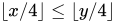
Hasse diagram of the prewellordering ⌊ x / 4 ⌋ ≤ ⌊ y / 4 ⌋ {\displaystyle \lfloor x/4\rfloor \leq \lfloor y/4\rfloor }   on the non-negative integers, shown up to 18. The associated equivalence relation is ⌊ x / 4 ⌋ = ⌊ y / 4 ⌋ ; {\displaystyle \lfloor x/4\rfloor =\lfloor y/4\rfloor ;}   it identifies the numbers in each light red square.

Given a set A , {\displaystyle A,}   the binary relation on the set X := Finite ⁡ ( A ) {\displaystyle X:=\operatorname {Finite} (A)}   of all finite subsets of A {\displaystyle A}   defined by S ≤ T {\displaystyle S\leq T}   if and only if | S | ≤ | T | {\displaystyle |S|\leq |T|}   (where | ⋅ | {\displaystyle |\cdot |}   denotes the set's cardinality) is a prewellordering.

Properties

If ≤ {\displaystyle \leq }   is a prewellordering on X , {\displaystyle X,}   then the relation ∼ {\displaystyle \sim }   defined by x ∼ y  if and only if  x ≤ y ∧ y ≤ x {\displaystyle x\sim y{\text{ if and only if }}x\leq y\land y\leq x}   is an equivalence relation on X , {\displaystyle X,}   and ≤ {\displaystyle \leq }   induces a wellordering on the quotient X / ∼ . {\displaystyle X/{\sim }.}   The order-type of this induced wellordering is an ordinal, referred to as the length of the prewellordering.

A norm on a set X {\displaystyle X}   is a map from X {\displaystyle X}   into the ordinals. Every norm induces a prewellordering; if ϕ : X → O r d {\displaystyle \phi :X\to Ord}   is a norm, the associated prewellordering is given by x ≤ y  if and only if  ϕ ( x ) ≤ ϕ ( y ) {\displaystyle x\leq y{\text{ if and only if }}\phi (x)\leq \phi (y)}   Conversely, every prewellordering is induced by a unique regular norm (a norm ϕ : X → O r d {\displaystyle \phi :X\to Ord}   is regular if, for any x ∈ X {\displaystyle x\in X}   and any α < ϕ ( x ) , {\displaystyle \alpha <\phi (x),}   there is y ∈ X {\displaystyle y\in X}   such that ϕ ( y ) = α {\displaystyle \phi (y)=\alpha }  ).

Prewellordering property

If Γ {\displaystyle {\boldsymbol {\Gamma }}}   is a pointclass of subsets of some collection F {\displaystyle {\mathcal {F}}}   of Polish spaces, F {\displaystyle {\mathcal {F}}}   closed under Cartesian product, and if ≤ {\displaystyle \leq }   is a prewellordering of some subset P {\displaystyle P}   of some element X {\displaystyle X}   of F , {\displaystyle {\mathcal {F}},}   then ≤ {\displaystyle \leq }   is said to be a Γ {\displaystyle {\boldsymbol {\Gamma }}}  -prewellordering of P {\displaystyle P}   if the relations < ∗ {\displaystyle <^{*}}   and ≤ ∗ {\displaystyle \leq ^{*}}   are elements of Γ , {\displaystyle {\boldsymbol {\Gamma }},}   where for x , y ∈ X , {\displaystyle x,y\in X,}  

  1. x < ∗ y  if and only if  x ∈ P ∧ ( y ∉ P ∨ ( x ≤ y ∧ y ≰ x ) ) {\displaystyle x<^{*}y{\text{ if and only if }}x\in P\land (y\notin P\lor (x\leq y\land y\not \leq x))}  
  2. x ≤ ∗ y  if and only if  x ∈ P ∧ ( y ∉ P ∨ x ≤ y ) {\displaystyle x\leq ^{*}y{\text{ if and only if }}x\in P\land (y\notin P\lor x\leq y)}  

Γ {\displaystyle {\boldsymbol {\Gamma }}}   is said to have the prewellordering property if every set in Γ {\displaystyle {\boldsymbol {\Gamma }}}   admits a Γ {\displaystyle {\boldsymbol {\Gamma }}}  -prewellordering.

The prewellordering property is related to the stronger scale property; in practice, many pointclasses having the prewellordering property also have the scale property, which allows drawing stronger conclusions.

Examples

Π 1 1 {\displaystyle {\boldsymbol {\Pi }}_{1}^{1}}   and Σ 2 1 {\displaystyle {\boldsymbol {\Sigma }}_{2}^{1}}   both have the prewellordering property; this is provable in ZFC alone. Assuming sufficient large cardinals, for every n ∈ ω , {\displaystyle n\in \omega ,}   Π 2 n + 1 1 {\displaystyle {\boldsymbol {\Pi }}_{2n+1}^{1}}   and Σ 2 n + 2 1 {\displaystyle {\boldsymbol {\Sigma }}_{2n+2}^{1}}   have the prewellordering property.

Consequences

Reduction

If Γ {\displaystyle {\boldsymbol {\Gamma }}}   is an adequate pointclass with the prewellordering property, then it also has the reduction property: For any space X ∈ F {\displaystyle X\in {\mathcal {F}}}   and any sets A , B ⊆ X , {\displaystyle A,B\subseteq X,}   A {\displaystyle A}   and B {\displaystyle B}   both in Γ , {\displaystyle {\boldsymbol {\Gamma }},}   the union A ∪ B {\displaystyle A\cup B}   may be partitioned into sets A ∗ , B ∗ , {\displaystyle A^{*},B^{*},}   both in Γ , {\displaystyle {\boldsymbol {\Gamma }},}   such that A ∗ ⊆ A {\displaystyle A^{*}\subseteq A}   and B ∗ ⊆ B . {\displaystyle B^{*}\subseteq B.}  

Separation

If Γ {\displaystyle {\boldsymbol {\Gamma }}}   is an adequate pointclass whose dual pointclass has the prewellordering property, then Γ {\displaystyle {\boldsymbol {\Gamma }}}   has the separation property: For any space X ∈ F {\displaystyle X\in {\mathcal {F}}}   and any sets A , B ⊆ X , {\displaystyle A,B\subseteq X,}   A {\displaystyle A}   and B {\displaystyle B}   disjoint sets both in Γ , {\displaystyle {\boldsymbol {\Gamma }},}   there is a set C ⊆ X {\displaystyle C\subseteq X}   such that both C {\displaystyle C}   and its complement X ∖ C {\displaystyle X\setminus C}   are in Γ , {\displaystyle {\boldsymbol {\Gamma }},}   with A ⊆ C {\displaystyle A\subseteq C}   and B ∩ C = ∅ . {\displaystyle B\cap C=\varnothing .}  

For example, Π 1 1 {\displaystyle {\boldsymbol {\Pi }}_{1}^{1}}   has the prewellordering property, so Σ 1 1 {\displaystyle {\boldsymbol {\Sigma }}_{1}^{1}}   has the separation property. This means that if A {\displaystyle A}   and B {\displaystyle B}   are disjoint analytic subsets of some Polish space X , {\displaystyle X,}   then there is a Borel subset C {\displaystyle C}   of X {\displaystyle X}   such that C {\displaystyle C}   includes A {\displaystyle A}   and is disjoint from B . {\displaystyle B.}  

See also

  • Descriptive set theory – Subfield of mathematical logic
  • Graded poset – a graded poset is analogous to a prewellordering with a norm, replacing a map to the ordinals with a map to the natural numbers
  • Scale property

wikipedia, wiki, encyclopedia, book, article, read, free download, Information about prewellordering. What is prewellordering? What does prewellordering mean?

←Next PostPrevious Post→
Most Read - Wikipedia
  • March 03, 2026

    Lloydminster

  • February 28, 2026

    Salem-Keizer Volcanoes

  • March 05, 2026

    Blood plasma

  • March 05, 2026

    Challenge Cup

  • March 07, 2026

    Documentalist

Studio

  • Wikipedia

Newsletter Signup

Get in touch
Contact us
© 2025 www.azur.en-us.nina.az - All rights reserved.
Copyright: Dadash Mammadov
Top