 Azərbaycanca (AZ)
 Deutsch (DE)
 English (US)
 Қазақша (KZ)
 Lietuva (LT)
 සිංහල (LK)
 Türkçe (TR)
 O'zbekcha (UZ)
 中國人 (CN)
A ball is a round object (usually spherical, but sometimes ovoid) with several uses. It is used in ball games, where the play of the game follows the state of the ball as it is hit, kicked or thrown by players. Balls can also be used for simpler activities, such as catch or juggling. Balls made from hard-wearing materials are used in engineering applications to provide very low friction bearings, known as ball bearings. Black-powder weapons use stone and metal balls as projectiles.
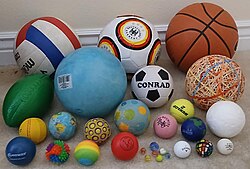
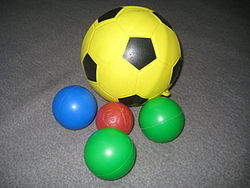
Although many types of balls are today made from rubber, this form was unknown outside the Americas until after the voyages of Columbus. The Spanish were the first Europeans to see the bouncing rubber balls (although solid and not inflated) which were employed most notably in the Mesoamerican ballgame. Balls used in various sports in other parts of the world prior to Columbus were made from other materials such as animal bladders or skins, stuffed with various materials.
As balls are one of the most familiar spherical objects to humans, the word "ball" may refer to or describe spherical or near-spherical objects. "Ball" is used metaphorically sometimes to denote something spherical or spheroid, e.g., armadillos and human beings curl up into a ball, or making a fist into a ball.
Etymology
The first known use of the word ball in English in the sense of a globular body that is played with was in 1205 in Layamon's Brut, or Chronicle of Britain in the phrase, "Summe heo driuen balles wide ȝeond Þa feldes." ("Some of them drove balls far across the fields.") The word came from the Middle English bal (inflected as ball-e, -es), in turn from Old Norse böllr (pronounced [bɔlːr]; compare Old Swedish baller, and Swedish boll) from Proto-Germanic ballu-z (whence probably Middle High German bal, ball-es, Middle Dutch bal), a cognate with Old High German ballo, pallo, Middle High German balle from Proto-Germanic *ballon (weak masculine), and Old High German ballâ, pallâ, Middle High German balle, Proto-Germanic *ballôn (weak feminine). No Old English cognate of any of these is known. (The hypothetical corresponding forms in Old English would have been beallu, -a, -e—compare bealluc, ballock.) If ball- was native in Germanic, it may have been a cognate with the Latin foll-is in sense of a "thing blown up or inflated." In the later Middle English spelling balle the word coincided graphically with the French balle "ball" and "bale" which has hence been erroneously assumed to be its source. French balle (but not boule) is assumed to be of Germanic origin, itself, however. In Ancient Greek the word πάλλα (palla) for "ball" is attested besides the word σφαίρα (sfaíra), sphere.
History

Some form of game with a ball is found portrayed on Egyptian monuments. In Homer, Nausicaa was playing at ball with her maidens when Odysseus first saw her in the land of the Phaeacians (Od. vi. 100). And Halios and Laodamas performed before Alcinous and Odysseus with ball play, accompanied with dancing (Od. viii. 370). The most ancient balls in Eurasia have been discovered in Karasahr, China and are 3000 years old. They were made of hair-filled leather.
Ancient Greeks
Among the ancient Greeks, games with balls (σφαῖραι) were regarded as a useful subsidiary to the more violent athletic exercises, as a means of keeping the body supple, and rendering it graceful, but were generally left to boys and girls. Of regular rules for the playing of ball games, little trace remains, if there were any such. The names in Greek for various forms, which have come down to us in such works as the Ὀνομαστικόν of Julius Pollux, imply little or nothing of such; thus, ἀπόρραξις (aporraxis) only means the putting of the ball on the ground with the open hand, οὐρανία (ourania), the flinging of the ball in the air to be caught by two or more players; φαινίνδα (phaininda) would seem to be a game of catch played by two or more, where feinting is used as a test of quickness and skill. Pollux (i. x. 104) mentions a game called episkyros (ἐπίσκυρος), which has often been looked on as the origin of football. It seems to have been played by two sides, arranged in lines; how far there was any form of "goal" seems uncertain. It was impossible to produce a ball that was perfectly spherical; children usually made their own balls by inflating pig's bladders and heating them in the ashes of a fire to make them rounder, although Plato (fl. 420s BC – 340s BC) described "balls which have leather coverings in twelve pieces".
Ancient Romans
Among the Romans, ball games were looked upon as an adjunct to the bath, and were graduated to the age and health of the bathers, and usually a place (sphaeristerium) was set apart for them in the baths (thermae). There appear to have been three types or sizes of ball, the pila, or small ball, used in catching games, the paganica, a heavy ball stuffed with feathers, and the follis, a leather ball filled with air, the largest of the three. This was struck from player to player, who wore a kind of gauntlet on the arm. There was a game known as trigon, played by three players standing in the form of a triangle, and played with the follis, and also one known as harpastum, which seems to imply a "scrimmage" among several players for the ball. These games are known to us through the Romans, though the names are Greek.
Modern ball games
The various modern games played with a ball or balls and subject to rules are treated under their various names, such as polo, cricket, football, etc.
Physics
In sports, many modern balls are pressurized. Some are pressurized at the factory (e.g. tennis, squash) and others are pressurized by users (e.g. volleyball, basketball, football). Almost all pressurized balls gradually leak air. If the ball is factory pressurized, there is usually a rule about whether the ball retains sufficient pressure to remain playable. Depressurized balls lack bounce and are often termed "dead". In extreme cases, a dead ball becomes flaccid. If the ball is pressured on use, there are generally rules about how the ball is pressurized before the match, and when (or whether) the ball can be repressurized or replaced.
Due to the ideal gas law, ball pressure is a function of temperature, generally tracking ambient conditions. Softer balls that are struck hard (especially squash balls) increase in temperature due to inelastic collision.
On the contrary, in certain sports ball is solid, some with uniform material (e.g. most hockey variations, lacrosse), others with different layered materials (e.g. baseball, cricket). Finally, some sports use hollow ones (e.g. sepaktakraw, pickleball, floorball).
- Cross section of sport balls
- Tennis
- Golf
- Baseball
In outdoor sports, wet balls play differently than dry balls. In indoor sports, balls may become damp due to hand sweat. Any form of humidity or dampness will affect a ball's surface friction, which will alter a player's ability to impart spin on the ball. The action required to apply spin to a ball is governed by the physics of angular momentum. Spinning balls travelling through air (technically a fluid) will experience the Magnus effect, which can produce lateral deflections in addition to the normal up-down curvature induced by a combination of wind resistance and gravity.
Specifications
| Sport | Regulated by | Type | Shape | Circumference | Diameter | Weight | Pressure | Bounce | Material | Image |
|---|---|---|---|---|---|---|---|---|---|---|
| Bat and ball sports | ||||||||||
| Baseball | WBSC | Solid | Sphere | 9–9.25 inches (22.9–23.5 cm) | - | 5–5.25 ounces (142–149 g) | - |
| | |
| Softball | 11.875–12.125 inches (30.16–30.80 cm) | - | 6.25–7 ounces (177–198 g) | - | 0.47 e |
| | |||
| Baseball5 | Filled with air, non inflatable | 20.84 centimeters | 6.64 centimeters | 84,8 grams | 7.99 kilograms-force (78.4 N; 17.6 lbf) (to press the ball into the center of inside by 30%) | 76 centimeters (from 150 centimeters in height, drop to marble floor) | natural rubber | |||
| Pêl-Fas | IBB | Solid | Sphere | 8.5–9 inches (22–23 cm) | - | 4.5–5 ounces (130–140 g) | | |||
| Pesäpallo | Finnish Pesäpallo Association | Solid | Sphere | 21.6–22.2 centimetres (8.5–8.7 in) | - | 160–165 grams (5.6–5.8 oz) | | |||
| Cricket | ICC | Solid | Sphere | 8.81–9 inches (22.4–22.9 cm) | - | 5.5–5.75 ounces (156–163 g) | - | | ||
| Oină | Romanian Oină Federation | Solid | Sphere | 24 centimeters | 8 centimeters | 140 grams |
| |||
| Schlagball | Filled with air, non inflatable | Sphere | 19-21 centimeters | - | 70-85 grams | - | red leather covered | |||
| Stoolball | Stoolball England | Solid | Sphere | 7–7.5 inches (18–19 cm) | - | 2.5–3 ounces (71–85 g) | ||||
| Boules | ||||||||||
| Boccia | BISFed | Solid | Sphere | 26.2-27.8 cm | - | 263-287 grams | - | vinyl, polyurethane fabric, leather, synthetic leather, suede | | |
| Bocce volo (bowl) | WPBF | Solid | Sphere | - | 8.9-11.1 centimeters | 900-1200 grams | - | metal or synthetic | | |
| Bocce volo (jack) | 3.5-3.7 centimeters | 23-27 grams | wood | |||||||
| Petanque (boule) | - | 7.05-8 centimeters | 650-800 grams | - | metal | | ||||
| Petanque (jack) | 2.9-3.1 centimeters | 10-18 grams | wood or synthetic | |||||||
| Raffa (bowl) | - | 10.55-10.75 centimeters | 895-925 grams | - | synthetic | |||||
| Raffa (pallino) | 3.9-4.1 centimeters | 83-97 grams | ||||||||
| Cue sports | ||||||||||
| Carom | WCBS | Solid | Sphere | - | 6.1-6.15 centimeters | 205-220 grams | - | | ||
| Pool | - | 2.25–2.3 inches (5.7–5.8 cm) | 5.5–6 ounces (160–170 g) | - | cast phenolic resin plastic | | ||||
| Snooker | - | 5.2-5.3 centimeters | - | - | | |||||
| Football codes | ||||||||||
| American | IFAF | Inflatable | Lemon | 28–28.5 inches (71–72 cm) (longitudinal) × 21–21.25 inches (53.3–54.0 cm) (transversal) | 11–11.25 inches (27.9–28.6 cm) (longitudinal) | 14–15 ounces (400–430 g) | 12.5–13.5 pounds per square inch (86–93 kPa) | urethane (bladder), case (leather) | | |
| Canadian | Football Canada | 27.75–28.5 inches (70.5–72.4 cm) (longitudinal) 20.75–21.375 inches (52.71–54.29 cm) (transversal) | 10.875–11.4375 inches (27.623–29.051 cm) (longitudinal) 6.25–6.75 inches (15.9–17.1 cm) (transversal) | | ||||||
| Soccer | FIFA | Inflatable | Sphere | 27–28 inches (69–71 cm) | - | 14–16 ounces (400–450 g) | 8.5–15.6 pounds per square inch (59–108 kPa) | - | - | |
| Beach soccer | 68-70 centimeters | - | 400-440 grams | 0.4–0.6 standard atmospheres (41–61 kPa) | - | - | | |||
| Futsal | 62-64 centimeters | - | 0.6–0.9 standard atmospheres (61–91 kPa) | 50-65 centimeters on the first rebound when dropped from a height of 2 meters | - | | ||||
| Australian rules | AFL Commission | Inflatable | Prolate spheroid | 72 – 73 cm (elliptic) × 54.5 -55.5 cm (circular) | - | - | 69 kilopascals | - | | |
| Gaelic and International rules | GAA | Inflatable | Sphere | 68-70 centimeters | - | 480-500 grams | 9–10 pounds per square inch (62–69 kPa) | 0.5222-0.576 e when dropped from 1.8 meters | - | |
| Rugby league | IRL | Inflatable | Prolate spheroid | leather | | |||||
| Rugby union | World Rugby | 74 - 77 centimeters (elliptic) × 58 - 62 centimeters (circular) | 28-30 centimeters (longitudinal) | 410 - 460 grams | 9.5–10 pounds per square inch (66–69 kPa) | leather or synthetic material | | |||
| Handball | ||||||||||
| Indoor (with resine) | IHF | Inflatable | Sphere | 58-60 centimeters | - | 425-475 grams | leather or synthetic | | ||
| Indoor (without resine) | 55.5-57.5 centimeters | - | 400-425 grams | |||||||
| Beach | 54-56 centimeters | - | 350-370 grams | rubber | | |||||
| Hockey | ||||||||||
| Ball hockey | ISBHF | Sphere | - | 6.6-7 centimeters | 60-77 grams | |||||
| Bandy and Rink bandy | FIB | Solid | Sphere | - | 6.1-6.5 centimeters | 60-65 grams | - | 15-30 centimeters on ice dropped from height of 1.5 meters | - | |
| Field and indoor | FIH | Solid | Sphere | 22.4-23.5 centimeters | - | 156-163 grams | - | - | | |
| Beach | 45 centimeters | - | 140-250 grams | - | - | |||||
| Floorball | IFF | Hollow | Sphere | - | 7.1-7.3 centimeters | 22-24 grams | - | 74-84 centimeters | | |
| Roller | World Skate | Solid | Sphere | - | 7.2 centimeters | 145-155 grams | - | pressed rubber/plastic | | |
| Lacrosse | ||||||||||
| Field and Box | World Lacrosse | Solid | Sphere | 7.75–8 inches (19.7–20.3 cm) | - | 5–5.25 ounces (142–149 g) | - | 45–49 inches (110–120 cm) on wooden floor from height of 72 inches (180 cm) | rubber | |
| Sixes | 19.7-20.3 centimeters | - | - | - | elastomeric | |||||
| Women | 20-20.3 centimeters | - | 142-149 grams | - | 1.1-1.3 meters on wooden floor dropped from height of 1.8 meters | |||||
| Intercrosse | Sphere | 23-25 centimeters | - | 80-100 grams | - | rubber | ||||
| Polo | ||||||||||
| Polo | FIP | Solid | Sphere | - | 3–3.5 inches (7.6–8.9 cm) | 3.5–4.75 ounces (99–135 g) | - | | ||
| Arena | 12.5–16.5 inches (32–42 cm) | - | 130-182 grams | from 9 feet (2.7 m) on concrete at 70 °F (21 °C), 54–64 inches (140–160 cm) rebound | | |||||
| Racquet sports | ||||||||||
| Pickleball | Multiple | Hollow | Sphere | - | 2.87 and 2.97 inches (73 and 75 mm) | .78 and .935 ounces (22.1 and 26.5 g) | 30 to 34 inches (760 to 860 mm) when dropped from a height of 78 inches (2,000 mm) | Molded material with a smooth surface with between 26 and 40 evenly spaced circular holes | | |
| Squash | WSF | Filled with air, non inflatable | Sphere | - | 3.95-4.05 centimeters | 23-25 grams | - | | ||
| Table tennis | ITTF | Filled with air, non inflatable | Sphere | - | 4 centimeters | 2.7 grams | - | plastic | | |
| Tennis | ITF | Filled with air, non inflatable | Sphere | - | 6.54–6.86 centimetres (2.57–2.70 in) | 56–59.4 grams (1.98–2.10 oz) | 1 pound per square inch (6.9 kPa) | 54–60 inches (140–150 cm) | | |
| Volleyball | ||||||||||
| Volleyball | FIVB | Inflatable | Sphere | 65-67 centimeters | - | 260 - 280 grams | 4.26–4.61 pounds per square inch (29.4–31.8 kPa) | rubber (bladder), leather or synthetic leather (case) | | |
| Beach and Snow | 66-68 centimeters | - | 17.1-22.1 kilopascals | | ||||||
| Other | ||||||||||
| Basketball | FIBA | Inflatable | Sphere | 75-77 centimeters | - | 580-620 grams | 1.035-1.085 meters dropped from height of 1.8 meters | leather, artificial/composite/synthetic leather | | |
| Bowling | IBF | Solid | Sphere | 26.704–27.002 inches (67.83–68.59 cm) | 8.5–8.595 inches (21.59–21.83 cm) | 16 pounds (7,300 g) | - | non-metallic | | |
| Cycle ball | UCI | Sphere | - | 17-18 centimeters | 500-600 grams | - | textile (case) | | ||
| Dodgeball | WDA | Inflatable | Sphere | - | 7 inches (18 cm) | 1.6–1.8 pounds per square inch (0.11–0.12 bar) | textile (case) | |||
| Fistball | IFA | Inflatable | Sphere | 65-68 centimeters | - | 340-360 grams | 0.55–0.7 bars (55–70 kPa) | |||
| Gaelic games | GAA | Solid | Sphere | - | 69–72 millimetres (2.7–2.8 in) | 110-116 grams | - | leather (case) | | |
| Goalball | IBSA | Hollow | Sphere | 75.5-78.5 centimeters | 24-25 centimeters | 1200-1300 grams | natural rubber with internal bells | |||
| Golf | IGF | Solid | Sphere | - | 1.68 inches (4.3 cm) | 1.62 ounces (46 g) | - | elastomeric material | | |
| Korfball | IKF | Inflatable | Sphere | 68-70.5 centimeters | - | 445-475 grams | 110-130 centimeters (from 180 centimeters in height) | |||
| Netball | World Netball | Inflatable | Sphere | 27–28 inches (69–71 cm) | - | 14–16 ounces (400–450 g) | leather, rubber or synthetic material. | |||
| Rhythmic gymnastics | World Gymnastics | Sphere | 56.5-62.8 centimeters | 18-20 centimeters | 400 grams minimum | Rubber or soft plastic | ||||
| Sepaktakraw | ISTAF | Hollow | Sphere | 41-43 centimeters | - | 170-180 grams | - | woven synthetic fiber | | |
| Shinty | Camanachd Association | Solid | Sphere | 7.5–8 inches (19–20 cm) | - | 2.5–3 ounces (71–85 g) | - |
| ||
| Tchoukball | FITB | Inflatable | Sphere | 58-60 centimeters | - | 425-475 grams | ||||
| Teqball | FITEQ | Inflatable | Sphere | 67-69 centimeter | - | 370-400 grams | 0.3–0.5 standard atmospheres (30–51 kPa) |
| ||
| Waterpolo and Canoe Polo | World Aquatics and ICF | Inflatable | Sphere | 68-71 centimeters | - | 400-450 grams | 7.5–8.5 pounds per square inch (52–59 kPa) | | ||
See also

- Ball (mathematics)
- Buckminster Fullerene "Bucky balls"
- Dryer ball, used in a tumbling dryer
- Football (ball)
- Hockey puck, can also spin, bounce, and roll
- Marbles
- Penny floater
- Shuttlecock
- Super Ball
wikipedia, wiki, encyclopedia, book, article, read, free download, Information about ball. What is ball? What does ball mean?