 Azərbaycanca (AZ)
 Deutsch (DE)
 English (US)
 Қазақша (KZ)
 Lietuva (LT)
 සිංහල (LK)
 Türkçe (TR)
 O'zbekcha (UZ)
 中國人 (CN)
Chronos (/ˈkroʊnɒs, -oʊs/; Ancient Greek: Χρόνος, romanized: Khronos, lit. 'Time'; [kʰrónos], Modern Greek: ['xronos]), also spelled Chronus, is a personification of time in Greek mythology, who is also discussed in pre-Socratic philosophy and later literature. His consort is the goddess Ananke.
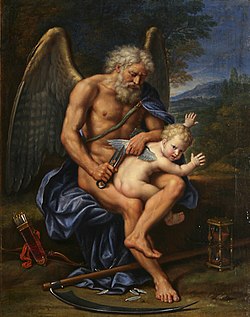
Chronos is frequently confused with, or perhaps consciously identified with, the Titan Cronus in antiquity, due to the similarity in names. The identification became more widespread during the Renaissance, giving rise to the iconography of Father Time wielding the harvesting scythe.
Greco-Roman mosaics depicted Chronos as a man turning the zodiac wheel. He is comparable to the deity Aion as a symbol of cyclical time. He is usually portrayed as an old, callous man with a thick grey beard, personifying the destructive and stifling aspects of time.
Name

During antiquity, Chronos was occasionally interpreted as Cronus. According to Plutarch, the Greeks believed that Cronus was an allegorical name for Chronos.
Mythology
In the Orphic tradition, the unaging Chronos was "engendered" by "earth and water", and produced Aether, Chaos, and an egg. The egg produced the hermaphroditic god Phanes who gave birth to the first generation of gods and is the ultimate creator of the cosmos.
Pherecydes of Syros in his lost Heptamychos ("The seven recesses"), around 6th century BC, claimed that there were three eternal principles: Chronos, Zas (Zeus) and Chthonie (the chthonic). The semen of Chronos was placed in the recesses of the Earth and produced the first generation of gods.
See also
- Kairos
- Father Time
wikipedia, wiki, encyclopedia, book, article, read, free download, Information about chronos. What is chronos? What does chronos mean?