 Azərbaycanca (AZ)
 Deutsch (DE)
 English (US)
 Қазақша (KZ)
 Lietuva (LT)
 සිංහල (LK)
 Türkçe (TR)
 O'zbekcha (UZ)
 中國人 (CN)
Art history is an academic discipline devoted to the study of artistic production and visual culture throughout human history. Art historians use a historical method or a philosophy, such as historical materialism or critical theory, to analyze artworks. Among other topics, they study art's impact on societies and cultures, the relationship between art and politics, and how artistic styles and formal characteristics of works of art have changed throughout history. As a discipline, art history is distinguished from art criticism, which is concerned with establishing a relative artistic value for critiquing individual works, and aesthetics, which is a branch of philosophy.
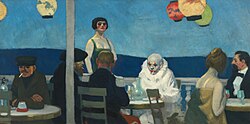
The study of art’s history emerged as a way to document and interpret artistic production. Early traditions of art-historical writing developed in several cultures, including Ancient Greece, Imperial China, and Renaissance Italy, each producing influential figures and approaches that shaped later scholarship. As an academic discipline, art history emerged in the 19th century and was a largely Eurocentric field, concentrating on Western definitions of the fine and decorative arts, particularly painting, drawing, sculpture, and architecture.
In contemporary era, however, art history has expanded to examine broader aspects of visual culture, including the various cultural, political, and socioeconomic issues related to art. Today, art history is a broad academic field encompassing numerous methodologies and interdisciplinary approaches to the study of artistic production globally, including European, Asian, African, or American Indigenous arts, among others. Some of the subfields include Marxist art history, feminist art history, iconography and the study of symbols, visual culture studies, and design history.
Methodologies

Art historians employ a number of methods in their research so they can examine work in the context of its time. This is professionally done in a manner which respects its creator's motivations and imperatives; with consideration of the desires and prejudices of its patrons and sponsors. A comparative analysis of themes and approaches of the creator's colleagues and teachers along with consideration of iconography and symbolism is part of the examination. In short, this approach examines the work of art in the context of the world within which it was created.
Art historians also often examine work through an analysis of form; that is, the creator's use of line, shape, color, texture and composition. This approach examines how the artist uses a two-dimensional picture plane or the three dimensions of sculptural or architectural space to create their art. The way these individual elements are employed results in representational or non-representational art.
An analysis of iconography is a large branch of art history which focuses on particular design elements of an object. Through a close reading of such elements, it is possible to trace their lineage, and with it draw conclusions regarding the origins and trajectory of these motifs. In turn, it is possible to make any number of observations regarding the social, cultural, economic and aesthetic values of those responsible for producing the object.
Art historians may also work alongside or as art conservators, helping restore and conserve artworks. Conservation is a scientific field that is crucial to historians work, due to them needing to observe a work that is a condition good enough to be examined. Training in art conservation typically involves coursework in chemistry as well as the practice and history of art.
Notable concentrations and fields of study
Most art historians choose a specific historical period within art history to specialize or gain an academic degree in. Concentrations on art movements, periods and certain fields such as Prehistoric art, Ancient art, Medieval art, Renaissance art, Romanticism, Realism, Modern art, Contemporary art, Pop art, Feminist art, Queer art and much more are common in the academic world. These periods of art movements attempt to cover the broader aspect of art history while distinctively separating them.
Feminist art history
In the 1970s, Linda Nochlin's essay "Why Have There Been No Great Women Artists?" helped to ignite feminist art history and remains one of the most widely read essays about female artists. This was followed by a 1972 College Art Association Panel, chaired by Nochlin, entitled "Eroticism and the Image of Woman in Nineteenth-Century Art". Within a decade, scores of papers, articles, and essays sustained a growing momentum, fueled by the Second-wave feminist movement, of critical discourse surrounding women's interactions with the arts as both artists and subjects. In her pioneering essay, Nochlin applies a feminist critical framework to show systematic exclusion of women from art training, arguing that exclusion from practicing art as well as the canonical history of art was the consequence of cultural conditions which curtailed and restricted women from art producing fields. The few who did succeed were treated as anomalies and did not provide a model for subsequent success. Griselda Pollock is another prominent feminist art historian, whose use of psychoanalytic theory is described above.
While feminist art history can focus on any time period and location, much attention has been given to the Modern era. Some of this scholarship centers on the feminist art movement, which referred specifically to the experience of women. Often, feminist art history offers a critical "re-reading" of the Western art canon, such as Carol Duncan's re-interpretation of Les Demoiselles d'Avignon. Two pioneers of the field are Mary Garrard and Norma Broude. Their anthologies Feminism and Art History: Questioning the Litany, The Expanding Discourse: Feminism and Art History, and Reclaiming Feminist Agency: Feminist Art History After Postmodernism are substantial efforts to bring feminist perspectives into the discourse of art history. The pair also co-founded the Feminist Art History Conference.
Museum studies
Art historians are often employed by museums due to their expertise in the field. Galleries, and archives are places where art historians may be in charge of exhibits, research or collections, depending on specialization factors. Museum studies, including the history of museum collecting and display, is now a specialized field of study, as is the history of collecting.
Timeline of prominent methods
wikipedia, wiki, encyclopedia, book, article, read, free download, Information about art historian. What is art historian? What does art historian mean?