 Azərbaycanca (AZ)
 Deutsch (DE)
 English (US)
 Қазақша (KZ)
 Lietuva (LT)
 සිංහල (LK)
 Türkçe (TR)
 O'zbekcha (UZ)
 中國人 (CN)
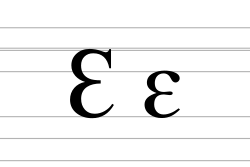
Latin epsilon or open E (majuscule: Ɛ, minuscule: ɛ) is a letter of the extended Latin alphabet, based on the lowercase of the Greek letter epsilon (ε). It was introduced in the 16th century by Gian Giorgio Trissino to represent the pronunciation of the "open e" (the letter e pronounced as the open-mid front unrounded vowel) in the Italian language; this use of the letter has since become the standard in IPA notation . Since the 20th century, the letter also occurs in the orthographies of many Niger–Congo and Nilo-Saharan languages, such as Ewe, Akan, Lingala, Dinka and Maasai, for the vowel [ɛ] or [e̙], and is included in the African reference alphabet.
| Latin epsilon | |||
|---|---|---|---|
| Ɛ ɛ | |||
 | |||
| Usage | |||
| Writing system | Latin script | ||
| Type | Alphabetic and logographic | ||
| Sound values |
| ||
| In Unicode | U+0190, U+025B | ||
| History | |||
| Development |
| ||
| Other | |||
| Writing direction | Left-to-Right | ||



In the Berber Latin alphabet used in Algerian Berber school books, and before that proposed by the French institute INALCO, it represents a voiced pharyngeal fricative [ʕ]. Some authors use ƹayin ⟨ƹ⟩ instead;[citation needed] both letters are similar in shape with the Arabic ʿayn ⟨ع⟩.
Use in phonetic alphabets
The International Phonetic Alphabet (IPA) uses various forms of the Latin epsilon:
- U+025B ɛ LATIN SMALL LETTER OPEN E represents the open-mid front unrounded vowel
- U+025D ɝ LATIN SMALL LETTER REVERSED OPEN E WITH HOOK represents the rhotacized open-mid central vowel
- U+025E ɞ LATIN SMALL LETTER CLOSED REVERSED OPEN E represents the open-mid central rounded vowel (shown as U+029A ʚ LATIN SMALL LETTER CLOSED OPEN E on the 1993 IPA chart)
The Uralic Phonetic Alphabet uses various forms of the Latin epsilon:
- U+1D08 ᴈ LATIN SMALL LETTER TURNED OPEN E
- U+1D4B ᵋ MODIFIER LETTER SMALL OPEN E
- U+1D4C ᵌ MODIFIER LETTER SMALL TURNED OPEN E
List of languages that use Latin epsilon
Niger–Congo
Akan, Bambara, Baule, Dagbani, Dogon, Douala. Ewe, Fante, Frafra, Fon, Ga, Jula, Kabiye, Kpelle, Kuya, Lingala, Loma, Mende, Moore, Soninke, Twi, Vai, Yoruba (in Benin)
Nilo-Saharan
Dinka, Maasai, Nuer, Songhai, Zarma.
Unicode
Latin epsilon is called "Open E" in Unicode.
| Preview | Ɛ | ɛ | ||
|---|---|---|---|---|
| Unicode name | LATIN CAPITAL LETTER OPEN E | LATIN SMALL LETTER OPEN E | ||
| Encodings | decimal | hex | dec | hex |
| Unicode | 400 | U+0190 | 603 | U+025B |
| UTF-8 | 198 144 | C6 90 | 201 155 | C9 9B |
| Numeric character reference | Ɛ | Ɛ | ɛ | ɛ |
See also
- Open O
- Writing systems of Africa (section on Latin script)
- Open-mid front unrounded vowel
- Greek Epsilon
- Epsilon Ԑ (Cyrillic script)
wikipedia, wiki, encyclopedia, book, article, read, free download, Information about latin epsilon. What is latin epsilon? What does latin epsilon mean?