 Azərbaycanca (AZ)
 Deutsch (DE)
 English (US)
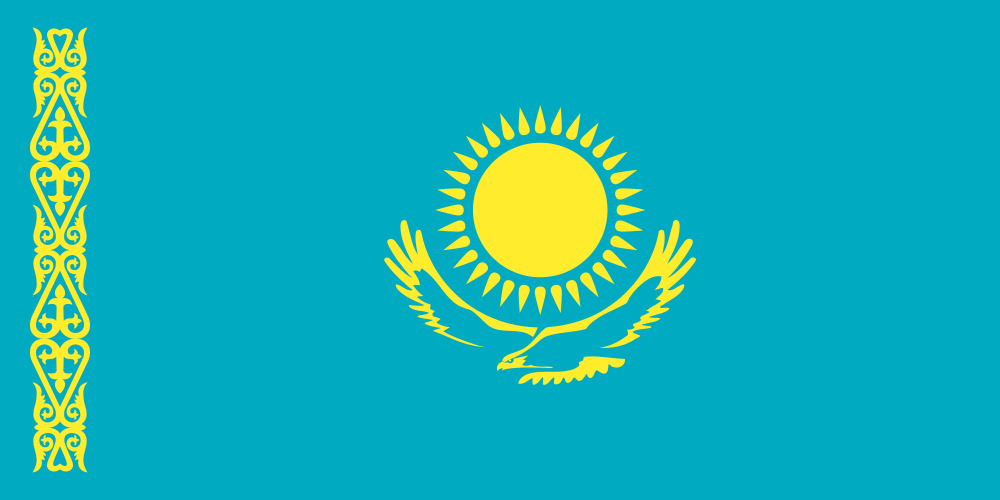 Қазақша (KZ)
 Lietuva (LT)
 සිංහල (LK)
 Türkçe (TR)
 O'zbekcha (UZ)
 中國人 (CN)
Kazakhstan, officially the Republic of Kazakhstan, is a landlocked country situated primarily in Central Asia, with a small portion of its territory extending into Eastern Europe. It borders Russia to the north and west, China to the east, Kyrgyzstan to the southeast, Uzbekistan to the south, and Turkmenistan to the southwest, and it has a coastline along the Caspian Sea. The capital is Astana, and Almaty, the country’s largest city and principal cultural and economic center, served as the capital until 1997.
Republic of Kazakhstan
| |
|---|---|
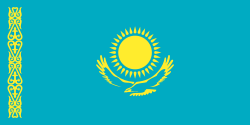 Flag 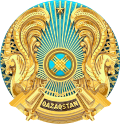 Emblem | |
| Anthem: Menıñ Qazaqstanym "My Kazakhstan" | |
 | |
| Capital | Astana 51°8′N 71°26′E / 51.133°N 71.433°E |
| Largest city | Almaty 43°14′N 76°57′E / 43.233°N 76.950°E |
| Official languages |
|
| Ethnic groups (2025) |
|
| Religion (2021) |
|
| Demonyms |
|
| Government | Unitary presidential republic under an authoritarian government |
• President | Kassym-Jomart Tokayev |
• Prime Minister | Oljas Bektenov |
| Legislature | Parliament |
| Senate | |
| Mäjilis | |
| Formation | |
• Kazakh Khanate | c. 1465 |
• Kazakh ASSR | 26 August 1920 |
• Kazakh SSR | 5 December 1936 |
• Independence from the Soviet Union | 16 December 1991 |
• Recognized | 26 December 1991 |
• Current constitution | 30 August 1995 |
| Area | |
• Total | 2,724,900 km2 (1,052,100 sq mi) (9th) |
• Water (%) | 1.7 |
| Population | |
• 2026 estimate |  20,495,975 (65th) 20,495,975 (65th) |
• Density | 7.44/km2 (19.3/sq mi) (236th) |
| GDP (PPP) | 2025 estimate |
• Total |  $904.500 billion (37th) $904.500 billion (37th) |
• Per capita | $44,450 (49th) |
| GDP (nominal) | 2025 estimate |
• Total | $300.540 billion (48th) |
• Per capita | $14,770 (64th) |
| Gini (2018) |  27.8 27.8low inequality |
| HDI (2023) | 0.837 very high (60th) |
| Currency | Tenge (₸) (KZT) |
| Time zone | UTC+5 |
| Calling code | +7 |
| ISO 3166 code | KZ |
| Internet TLD |
|
Kazakhstan is the world's ninth-largest country by land area and the largest landlocked country. Hilly plateaus and plains account for nearly half its vast territory, with lowlands composing another third; its southern and eastern frontiers are composed of mountainous regions. Kazakhstan has a population of 20.5 million and one of the lowest population densities in the world, with fewer than 8 people per square kilometre (21 people/mi2). Ethnic Kazakhs constitute a majority, while ethnic Russians form a significant minority. Officially secular, Kazakhstan is a Muslim-majority country with a sizeable Christian community.
Kazakhstan has been inhabited since the Paleolithic era. In antiquity, various nomadic Iranian peoples such as the Saka, Massagetae, and Scythians dominated the territory, with the Achaemenid Persian Empire expanding towards the south. Turkic nomads entered the region from the sixth century. In the 13th century, the area was subjugated by the Mongol Empire under Genghis Khan. Following the disintegration of the Golden Horde in the 15th century, the Kazakh Khanate was established over an area roughly corresponding with modern Kazakhstan. By the 18th century, the Kazakh Khanate had fragmented into three jüz (tribal divisions), which were gradually absorbed and conquered by the Russian Empire; by the mid-19th century, all of Kazakhstan was nominally under Russian rule. Following the 1917 Russian Revolution and subsequent Russian Civil War, it became an autonomous republic of the Russian SFSR within the Soviet Union. Its status was elevated to that of a union republic in 1936. The Soviet government settled Russians and other ethnicities in the republic, which resulted in ethnic Kazakhs being a minority during the Soviet era. Kazakhstan was the last constituent republic of the Soviet Union to declare independence in 1991 during its dissolution.
Kazakhstan dominates Central Asia both economically and politically, accounting for 60% of the region's GDP, primarily through its oil and gas industry; it also has vast mineral resources, ranking among the highest producers of iron and silver in the world. Kazakhstan also has the highest Human Development Index ranking in the region. It is a unitary constitutional republic; however, its government is authoritarian. Nevertheless, there have been incremental efforts at democratization and political reform since the resignation of Nursultan Nazarbayev in 2019, who had led the country since independence. Kazakhstan is a member state of the United Nations, World Trade Organization, Commonwealth of Independent States, Shanghai Cooperation Organization, Eurasian Economic Union, Collective Security Treaty Organization, Organization for Security and Cooperation in Europe, Organization of Islamic Cooperation, Organization of Turkic States, International Organization of Turkic Culture and Special Guest status with the Council of Europe Parliamentary Assembly.
Etymology
According to the most widely accepted theory, the word qazaq (Kazakh) derives from a Turkic root meaning "free", "independent", or "wanderer".
The Turkic word qazaq (قازاق) was reliably recorded in 13th–14th century dictionaries, including the Codex Cumanicus and a Mamluk-Kipchak Arabic dictionary published by Martin Houtsma. In these sources, the word meant "unattached", "homeless", "loner", or "exile", and later acquired the meaning "free man".
The English word Kazakh, meaning a member of the Kazakh people, derives from Russian: казах. The native name is қазақ, qazaq. It might originate from the Turkic word verb qaz-, 'to wander', reflecting the Kazakhs' nomadic culture. The term Cossack is of the same origin.
In Turko-Persian sources, the term Özbek-Qazaq first appeared during the mid-16th century, in the Tarikh-i-Rashidi by Mirza Muhammad Haidar Dughlat, a Chagatayid prince of Kashmir, which locates Kazakh in the eastern part of Desht-i Qipchaq. According to Vasily Bartold, the Kazakhs likely began using that name during the 15th century.
Though Kazakh traditionally referred only to ethnic Kazakhs, including those living in China, Russia, Turkey, Uzbekistan, and other neighbouring countries, the term is increasingly being used to refer to any inhabitant of Kazakhstan, including residents of other ethnicities. In the Kazakh language, the country is called Qazaqstan in the Latin script.
History
wikipedia, wiki, encyclopedia, book, article, read, free download, Information about kazakhstan. What is kazakhstan? What does kazakhstan mean?