 Azərbaycanca (AZ)
 Deutsch (DE)
 English (US)
 Қазақша (KZ)
 Lietuva (LT)
 සිංහල (LK)
 Türkçe (TR)
 O'zbekcha (UZ)
 中國人 (CN)
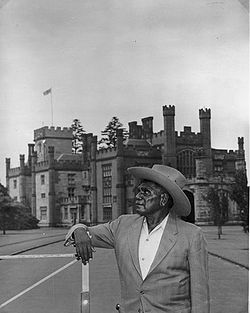
The Arrernte (/ˈʌrəndə/) people, (also Aranda, Arunta or Arrarnta), are a group of Aboriginal Australian peoples who live in the Arrernte lands, at Mparntwe (Alice Springs) and surrounding areas of the Central Australia region of the Northern Territory. Many still speak one of the various Arrernte dialects. Some Arrernte live in other areas far from their homeland, including the major Australian cities and overseas.
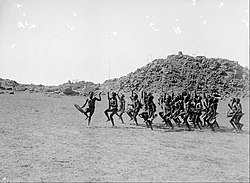
Arrernte spirituality focuses on the landscape and The Dreaming which the Arrernte name for is Altyerre. Altjira is the creator being of the Inapertwa that became all living creatures. Tjurunga are objects of religious significance.
The Arrernte Council is the representative and administrative body for the Arrernte Lands and is part of the Central Land Council.
Tourism is important to the economy of Alice Springs and surrounding communities.
Arrernte languages
"Aranda" is a simplified, Australian English approximation of the traditional pronunciation of the name of Arrernte [ˈarəɳ͡ɖa]. The ancestors of the Arrernte all spoke one or more of the many Arrernte dialects in the Arrernte group of languages. Today several are completely or nearly extinct, but some (especially Eastern or Central Arrernte) are widely spoken and taught in schools.
The Arrernte also had a highly developed sign language.
Culture

Arrernte religion and cultural life were documented thoroughly from the late nineteenth century by the Lutheran missionary Carl Strehlow, the seminal Australian anthropologists Walter Baldwin Spencer and Francis Gillen and later by T. G. H. Strehlow. The Arrernte men worked with Strehlow to document their songs and ceremonies between 1932 and 1974. Arrernte oral history discusses the region of Alice Springs (Mparntwe) and its environs being shaped by primordial caterpillar-beings known as Ayepe-arenye (Hyles livornicoides), Ntyarlke (Hippotion celerio), and Utnerrengatye (Coenotes eremophilae) which were ancestral to the Arrernte people. The eastern MacDonnell Ranges was formed by the Ayepe-arenye, while the western portion of the ranges was formed by Ntyarlke.
Country
The Arrernte's lands, according to Norman Tindale's estimate, encompass some 47,000 square miles (120,000 km2). Of their overall territory he wrote that they were:
At Mount Gosse, Mount Zeil, and Mount Heughlin; on the Finke River to Idracowra, Blood Creek, Macumba, Mount Dare, and Andado, and some distance east into the sandhills of the Arunta (Simpson) Desert; northeast to Intea on the lower Hale River, thence north to Ilbala on Plenty River; west to Inilja and Hart Range, Mount Swan, Gillen Creek, Connor Well, and Narwietooma; in Central MacDonnell, James, and Ooraminna Ranges.
Sub-divisions
The name Arrernte refers to the following distinct groups (or "mobs"):
- Central Arrernte, from the township of Alice Springs and its immediate surrounds.
- Eastern Arrernte, from the Arrernte lands east of Alice Springs.
- Western Arrarnta, from the Arrernte lands west of Alice Springs, out to Mutitjulu and King's Canyon.
See also
- Arrernte language
- Veronica Perrule Dobson
- HMAS Arunta
- Margaret Kemarre Turner
- Spirituality and mythology
- Altjira
- Inapertwa
- Tjurunga
General and cited sources
- "Aboriginal Art Culture and Tourism Australia". Aboriginal Australia Art & Culture Centre. Retrieved 23 March 2013.
- "AIATSIS map of Indigenous Australia". AIATSIS. 28 March 2025.
- Brooks, David (1991). A Town Like Mparntwe: A Guide to the Dreaming Tracks and Sites of Alice Springs. Jukurrpa Books. ISBN 978-1-864-65045-7.
- Dixon, R. M. W. (2002). Australian Languages: Their Nature and Development. Cambridge University Press. ISBN 978-0-521-47378-1.
- Gibson, Jason (2020). Ceremony Men: Making Ethnography and the Return of the Strehlow Collection. SUNY Press. ISBN 9781438478548.
- Kearney, Simon (20 September 2007). "Another language faces sunset in dead centre" (PDF). The Australian, Swarthmore College.
- Kendon, Adam (1988). Sign Languages of Aboriginal Australia: Cultural, Semiotic and Communicative Perspectives. Cambridge University Press. ISBN 978-0-521-36008-1.
- Kenny, Anna (2013). The Aranda's Pepa: An introduction to Carl Strehlow's Masterpiece Die Aranda- und Loritja-Stämme in Zentral-Australien (1907-1920). Australian National University. ISBN 978-1-921-53677-9. JSTOR j.ctt5hgz6k.10.
- Morton, John (2013). "'Less was hidden among these children': Géza Roheim, Anthropology and the Politics of Aboriginal Childhood". In Eickelkamp, Ute (ed.). Growing Up In Central Australia: New Anthropological Studies of Aboriginal Childhood and Adolescence. Berghahn Books. pp. 15–48. ISBN 978-1-782-38127-3.
- Ryan, Mark David; Deane, Michael; Cunningham, Stuart (2008). "Australian Indigenous Art: Local Dreamings, Global Consumption". In Anheier, Helmut K.; Isar, Yudhishthir Raj (eds.). Cultures and Globalization: The Cultural Economy. SAGE. pp. 284–291. ISBN 978-1-473-90357-9.
- Short, John Rennie (2013). Globalization, Modernity and the City. Routledge. ISBN 978-1-136-67151-7.
- Strehlow, C. (1907). Leonhardi, Moritz von (ed.). Die Aranda- und Loritja-Stämme in Zentral-Australien: Part 1 Mythen, Sagen und Märchen des Aranda –Stammes (PDF). Joseph Baer & Co.
- Strehlow, C. (1908). Leonhardi, Moritz von (ed.). Die Aranda- und Loritja-Stämme in Zentral-Australien: Part 2. Mythen, Sagen und Märchen des Loritja–Stämmes (PDF). Joseph Baer & Co.
- Strehlow, C. (1910). Leonhardi, Moritz von (ed.). Die Aranda- und Loritja-Stämme in Zentral-Australien Part 3 (PDF). Joseph Baer & Co.
- Strehlow, C. (1913a). Die Aranda- und Loritja-Stämme in Zentral-Australien Part 4: Abteilung (PDF). Joseph Baer & Co.
- Strehlow, C. (1913b). Die Aranda- und Loritja-Stämme in Zentral-Australien.: Part 4. 1 Abteilung: Stammbaum Tafeln (PDF). Joseph Baer & Co.
- Strehlow, C. (1920). Die Aranda- und Loritja-Stämme in Zentral-Australien: Part 5 (PDF). Joseph Baer & Co.
- Tindale, Norman Barnett (1974). "Aranda". Aboriginal Tribes of Australia: Their Terrain, Environmental Controls, Distribution, Limits, and Proper Names. Australian National University Press. ISBN 978-0-708-10741-6. Archived from the original on 20 March 2020.
- Turpin, Myfany (August 2004). "Have you ever wondered why Arrernte is spelt the way it is?". Central Land Council.
wikipedia, wiki, encyclopedia, book, article, read, free download, Information about arrernte people. What is arrernte people? What does arrernte people mean?