 Azərbaycanca (AZ)
 Deutsch (DE)
 English (US)
 Қазақша (KZ)
 Lietuva (LT)
 සිංහල (LK)
 Türkçe (TR)
 O'zbekcha (UZ)
 中國人 (CN)
A semi-presidential system, or dual executive system, is a system in which a president exists alongside a prime minister and a cabinet, with the latter of the two being responsible to the legislature of the state. It differs from a parliamentary system in that it has an executive president independent of the legislature; and from the presidential system in that the cabinet, although named by the president, is responsible to the legislature, which may force the cabinet to resign through a motion of no confidence.
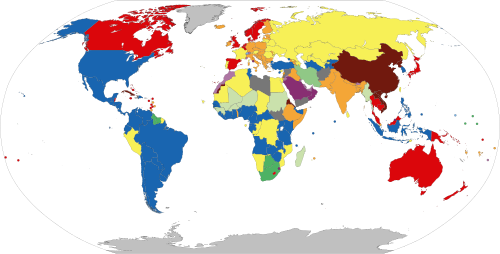
-
Parliamentary systems: Head of government is elected or nominated by and accountable to the legislature.Constitutional monarchy with a ceremonial monarchParliamentary republic with a ceremonial presidentParliamentary republic with an executive president
Presidential system: Head of government (president) is popularly elected and independent of the legislature.Presidential republic
Hybrid systems:Semi-presidential republic: Executive president is independent of the legislature; head of government is appointed by the president and is accountable to the legislature.Assembly-independent republic: Head of government (president or directory) is elected by the legislature, but is not accountable to it.
Other systems:Theocratic republic: Supreme leader is head of both the state and the faith, and holds significant executive and legislative powerSemi-constitutional monarchy: Monarch holds significant executive or legislative power but is still restricted by the constitution.Absolute monarchy: Monarch has unlimited power.One-party state: Power is constitutionally linked to a single political party.Military junta: Committee of military leaders controls the government; constitutional provisions are suspended.Governments with no constitutional basis: No constitutionally defined basis to current regime, i.e., provisional governments or Islamic theocracies.Dependent territories or places without governments
Note: this chart represents the de jure systems of government, not the de facto degree of democracy.
While the Weimar Republic (1919–1933) and Finland (from 1919 to 2000) exemplified early semi-presidential systems, the term "semi-presidential" was first introduced in 1959, in an article by the journalist Hubert Beuve-Méry, and popularized by a 1978 work written by the political scientist Maurice Duverger. Both men intended to describe the French Fifth Republic (established in 1958).
Definition
Maurice Duverger's original definition of semi-presidentialism stated that the president had to be elected, possess significant power, and serve for a fixed term.
Others, such as Robert Elgie propose an alternate definition which simply requires that "a popularly-elected fixed-term president exists alongside a prime minister and cabinet who are responsible to parliament."
Subtypes
There are two distinct subtypes of semi-presidentialism: premier-presidentialism and president-parliamentarism.
Under the premier-presidential system, the prime minister and cabinet are exclusively accountable to parliament. The president may choose the prime minister and cabinet, but only the parliament may approve them and remove them from office with a vote of no confidence. This system is much closer to pure parliamentarism. This subtype is used in: Burkina Faso, Cape Verde, East Timor, France, Lithuania, Madagascar, Mali, Mongolia, Niger, Georgia, Portugal, Romania, São Tomé and Príncipe, Sri Lanka, Turkey, and Ukraine.
Under the president-parliamentary system, the prime minister and cabinet are dually accountable to the president and the parliament. The president chooses the prime minister and the cabinet but must have the support of a parliamentary majority for his choice. To remove a prime minister, or the whole cabinet, from power, the president can either dismiss them, or the parliament can remove them through a vote of no confidence. This form of semi-presidentialism is much closer to pure presidentialism. It is used in: Azerbaijan, Guinea-Bissau, Kazakhstan, Mozambique, Russia, and Taiwan. It was also used in Ukraine, Georgia, South Korea under the Fourth and Fifth republics, and in Germany during the Weimar Republic.
Cohabitation
In a semi-presidential system, the president and the prime minister may sometimes be from different political parties. This is called "cohabitation", a term which originated in France after the situation first arose in the 1980s. Cohabitation can create either an effective system of checks and balances, or a period of bitter and tense stonewalling, depending on the attitudes of the two leaders, the ideologies of themselves/their parties, and the demands of their supporters.
Division of powers
The distribution of power between the president and the prime minister can vary greatly between countries.
In France, for example, in the case of cohabitation, the president oversees foreign policy and defence policy (these are generally called les prérogatives présidentielles, presidential prerogatives) and the prime minister is in charge of domestic policy and economic policy. In this case, the division of responsibilities between the prime minister and the president is not explicitly stated in the constitution, but has evolved as a political convention based on the constitutional principle that the prime minister is appointed (with the subsequent approval of a parliament majority) and dismissed by the president. On the other hand, whenever the president and the prime minister represent the same political party, which leads the cabinet, they tend to exercise de facto control over all fields of policy via the prime minister. However, it is up to the president to decide how much autonomy is left to said prime minister.
In most cases, cohabitation results from a system in which the two executives are not elected at the same time or for the same term. For example, in 1981, France elected both a Socialist president and legislature, which yielded a Socialist premier. But while the president's term of office was for seven years, the National Assembly only served for five. When, in the 1986 legislative election, the French people elected a right-of-centre assembly, Socialist president François Mitterrand was forced into cohabitation with right-wing premier Jacques Chirac.
However, in 2000, amendments to the French constitution reduced the length of the French president's term to five years. This has significantly lowered the chances of cohabitation occurring, as parliamentary and presidential elections may now be conducted within a shorter span of each other.
Advantages and disadvantages
The incorporation of elements from both presidential and parliamentary systems can bring certain advantageous elements; however, it also creates disadvantages, often related to the confusion produced by mixed authority patterns. It can be argued that a semi-presidential system is more likely to engage in democratic backsliding and power struggles, especially ones with a president-parliamentary system.
Advantages
- Parliament can remove an unpopular prime minister, therefore maintaining stability throughout the president's fixed term.
- In most semi-presidential systems, important segments of bureaucracy are taken away from the president, creating additional checks and balances where the running of the day-to-day government and its issues are separate from the head of state, and as such, its issues tend to be looked at on their own merits, with their ebbs and flows and not necessarily tied to who the head of state is.
- Having a separate head of government who needs to command the confidence of the parliament is seen as being more in tune to the political and economic development of the country. Because the head of government is elected from the parliament, there is little potential for political gridlock to occur, since the parliament has the power to remove the head of government if needed.
Disadvantages
- The system provides cover for the president, as unpopular policies could be blamed on the prime minister, who runs the day-to-day operations of the government.
- It creates a sense of confusion towards accountability, as there is no relatively clear sense of who is responsible for policy successes and failures.
- It creates both confusion and inefficiency in the legislative process, since the capacity of votes of confidence makes the prime minister respond to the parliament.
Countries with a semi-presidential system of government
President-parliamentary systems
In a president-parliamentary system, the prime minister and cabinet are dually accountable to the president and the legislature.
 Austria
 Azerbaijan
 Belarus
 Chad
Chad Congo, Republic of the
 Guinea-Bissau
 Kazakhstan
 Mauritania
 Mozambique
 Namibia
 Peru
Peru Russia
 Rwanda
 South Ossetia
 Taiwan
 Transnistria
 Uzbekistan
Non-UN members or observers are in italics.
Premier-presidential systems
In a premier-presidential system, the prime minister and cabinet are exclusively accountable to the legislature.


Non-UN members or observers are in italics.
Former semi-presidential countries
 All-Palestine (1948–1959)
 Armenia (1991–2018)
 Bangladesh (1975–1991)
 Croatia (1990–2000)
 Cuba (1940–1976)
 Finland (1919–2000)
 Georgia (1991–1995, 2004–2019)
 Germany (1919–1933)
 Greece (1973–1974)
 Kyrgyzstan (1993–2021)
 Mali (1991–2023)
 Moldova (1990–2001)
 North Macedonia (1991–2001)
 North Vietnam (1945–1959)
 Pakistan (1985-1997, 2003-2010)
 Philippines (1978–1986)
 Russian SFSR (July–November 1991)
 Somalia (1960–1969)
 Soviet Union (1990–1991)
- South Korea (1972–1988)
See also
- List of countries by system of government
- Parliamentary system
- Presidential system
- Semi-parliamentary system
wikipedia, wiki, encyclopedia, book, article, read, free download, Information about semi-presidential republic. What is semi-presidential republic? What does semi-presidential republic mean?