 Azərbaycanca (AZ)
 Deutsch (DE)
 English (US)
 Қазақша (KZ)
 Lietuva (LT)
 සිංහල (LK)
 Türkçe (TR)
 O'zbekcha (UZ)
 中國人 (CN)
Middle Chinese (formerly known as Ancient Chinese) or the Qieyun system (QYS) is the historical variety of Chinese recorded in the Qieyun, a rhyme dictionary first published in 601 and followed by several revised and expanded editions. The Swedish linguist Bernhard Karlgren believed that the dictionary recorded a speech standard of the capital Chang'an of the Sui and Tang dynasties. However, based on the preface of the Qieyun, most scholars now believe that it records a compromise between northern and southern reading and poetic traditions from the late Northern and Southern dynasties period. This composite system contains important information for the reconstruction of the preceding system of Old Chinese phonology (early 1st millennium BC).
| Middle Chinese | |||||||||||||||||||||||
|---|---|---|---|---|---|---|---|---|---|---|---|---|---|---|---|---|---|---|---|---|---|---|---|
| Ancient Chinese | |||||||||||||||||||||||
| 漢語 hɑnH ŋɨʌX | |||||||||||||||||||||||
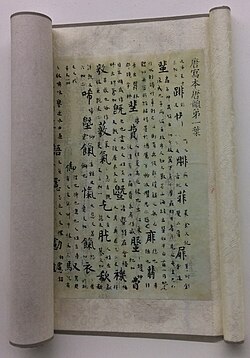 Part of the Tangyun, an 8th-century edition of the Qieyun dictionary | |||||||||||||||||||||||
| Native to | China | ||||||||||||||||||||||
| Era | 4th–12th centuries Northern and Southern dynasties, Sui, Tang, Five Dynasties and Ten Kingdoms period, Song | ||||||||||||||||||||||
Early forms | Old Chinese
| ||||||||||||||||||||||
| Chinese characters | |||||||||||||||||||||||
| Language codes | |||||||||||||||||||||||
| ISO 639-3 | ltc | ||||||||||||||||||||||
ltc | |||||||||||||||||||||||
| Glottolog | midd1344 | ||||||||||||||||||||||
| Chinese name | |||||||||||||||||||||||
| Traditional Chinese | 中古漢語 | ||||||||||||||||||||||
| Simplified Chinese | 中古汉语 | ||||||||||||||||||||||
| |||||||||||||||||||||||
The fanqie method used to indicate pronunciation in these dictionaries, though an improvement on earlier methods, proved awkward in practice. The mid-12th-century Yunjing and other rime tables (aka rhyme tables) incorporate a more sophisticated and convenient analysis of the Qieyun phonology. The rime tables attest to a number of sound changes that had occurred over the centuries following the publication of the Qieyun. Linguists sometimes refer to the system of the Qieyun as Early Middle Chinese and the variant revealed by the rime tables as Late Middle Chinese.
The dictionaries and tables describe pronunciations in relative terms, but do not give their actual sounds. Karlgren was the first to attempt a reconstruction of the sounds of Middle Chinese, comparing its categories with modern varieties of Chinese and the Sino-Xenic pronunciations used in the reading traditions of neighbouring countries. Several other scholars have produced their own reconstructions using similar methods.
The Qieyun system is often used as a framework for Chinese dialectology. With the exception of Min varieties, which show independent developments from Old Chinese, modern Chinese varieties can be largely treated as divergent developments from Middle Chinese. The study of Middle Chinese also provides for a better understanding and analysis of Classical Chinese poetry, such as the study of Tang poetry.
Methodology

The rime dictionaries and rime tables yield phonological categories, but with little hint of what sounds they represent. At the end of the 19th century, European students of Chinese sought to solve this problem by applying the methods of historical linguistics that had been used in reconstructing Proto-Indo-European. Volpicelli (1896) and Schaank (1897) compared the rime tables at the front of the Kangxi Dictionary with modern pronunciations in several varieties, but had little knowledge of linguistics.
Bernhard Karlgren, trained in transcription of Swedish dialects, carried out the first systematic survey of modern varieties of Chinese. He used the oldest known rime tables as descriptions of the sounds of the rime dictionaries, and also studied the Guangyun, at that time the oldest known rime dictionary. Unaware of Chen Li's study, he repeated the analysis of the fanqie required to identify the initials and finals of the dictionary. He believed that the resulting categories reflected the speech standard of the capital Chang'an of the Sui and Tang dynasties. He interpreted the many distinctions as a narrow transcription of the precise sounds of this language, which he sought to reconstruct by treating the Sino-Xenic and modern dialect pronunciations as reflexes of the Qieyun categories. A small number of Qieyun categories were not distinguished in any of the surviving pronunciations, and Karlgren assigned them identical reconstructions.
Karlgren's transcription involved a large number of consonants and vowels, many of them very unevenly distributed. Accepting Karlgren's reconstruction as a description of medieval speech, Chao Yuen Ren and Samuel E. Martin analysed its contrasts to extract a phonemic description. Hugh M. Stimson used a simplified version of Martin's system as an approximate indication of the pronunciation of Tang poetry. Karlgren himself viewed phonemic analysis as a detrimental "craze".
Older versions of the rime dictionaries and rime tables came to light over the first half of the 20th century, and were used by such linguists as Wang Li, Dong Tonghe and Li Rong in their own reconstructions. Edwin Pulleyblank argued that the systems of the Qieyun and the rime tables should be reconstructed as two separate (but related) systems, which he called Early and Late Middle Chinese, respectively. He further argued that his Late Middle Chinese reflected the standard language of the late Tang dynasty.
The preface of the Qieyun recovered in 1947 indicates that it records a compromise between northern and southern reading and poetic traditions from the late Northern and Southern dynasties period (a diasystem). Most linguists now believe that no single dialect contained all the distinctions recorded, but that each distinction did occur somewhere. Several scholars have compared the Qieyun system to cross-dialectal descriptions of English pronunciations, such as John C. Wells's lexical sets, or the notation used in some dictionaries. For example, the words "trap", "bath", "palm", "lot", "cloth" and "thought" contain four different vowels in Received Pronunciation and three in General American; these pronunciations and others can be specified in terms of these six cases.
Although the Qieyun system is no longer viewed as describing a single form of speech, linguists argue that this enhances its value in reconstructing earlier forms of Chinese, just as a cross-dialectal description of English pronunciations contains more information about earlier forms of English than any single modern form. The emphasis has shifted from precise phones to the structure of the phonological system. Li Fang-Kuei, as a prelude to his reconstruction of Old Chinese, produced a revision of Karlgren's notation, adding new notations for the few categories not distinguished by Karlgren, without assigning them pronunciations. This notation is still widely used, but its symbols, based on Johan August Lundell's Swedish Dialect Alphabet, differ from the familiar International Phonetic Alphabet. To remedy this, William H. Baxter produced his own notation for the Qieyun and rime table categories for use in his reconstruction of Old Chinese.
All reconstructions of Middle Chinese since Karlgren have followed his approach of beginning with the categories extracted from the rime dictionaries and tables, and using dialect and Sino-Xenic data (and in some cases transcription data) in a subsidiary role to fill in sound values for these categories. Jerry Norman and W. South Coblin have criticized this approach, arguing that viewing the dialect data through the rime dictionaries and rime tables distorts the evidence. They argue for a full application of the comparative method to the modern varieties, supplemented by systematic use of transcription data.
Phonology
The traditional analysis of the Chinese syllable, derived from the fanqie method, is into an initial consonant, or "initial", (shēngmǔ 聲母) and a final (yùnmǔ 韻母). Modern linguists subdivide the final into an optional "medial" glide (yùntóu 韻頭), a main vowel or "nucleus" (yùnfù 韻腹) and an optional final consonant or "coda" (yùnwěi 韻尾). Most reconstructions of Middle Chinese include the glides /j/ and /w/, as well as a combination /jw/, but many also include vocalic "glides" such as /i̯/ in a diphthong /i̯e/. Final consonants /j/, /w/, /m/, /n/, /ŋ/, /p/, /t/ and /k/ are widely accepted, sometimes with additional codas such as /wk/ or /wŋ/. Rhyming syllables in the Qieyun are assumed to have the same nuclear vowel and coda, but often have different medials.
Middle Chinese reconstructions by different modern linguists vary. These differences are minor and fairly uncontroversial in terms of consonants; however, there is a more significant difference as to the vowels. The most widely used transcriptions are Li Fang-Kuei's modification of Karlgren's reconstruction and William Baxter's typeable notation.
Initials
The preface of the Yunjing identifies a traditional set of 36 initials, each named with an exemplary character. An earlier version comprising 30 initials is known from fragments among the Dunhuang manuscripts. In contrast, identifying the initials of the Qieyun required a painstaking analysis of fanqie relationships across the whole dictionary, a task first undertaken by the Cantonese scholar Chen Li in 1842 and refined by others since. This analysis revealed a slightly different set of initials from the traditional set. Moreover, most scholars believe that some distinctions among the 36 initials were no longer current at the time of the rime tables, but were retained under the influence of the earlier dictionaries.
Early Middle Chinese (EMC) had three types of stops: voiced, voiceless, and voiceless aspirated. There were five series of coronal obstruents, with a three-way distinction between dental (or alveolar), retroflex and palatal among fricatives and affricates, and a two-way dental/retroflex distinction among stop consonants. The following table shows the initials of Early Middle Chinese, with their traditional names and approximate values:
| Stops and affricates | Nasals | Fricatives | Approximants | ||||
|---|---|---|---|---|---|---|---|
| Tenuis | Aspirate | Voiced | Tenuis | Voiced | |||
| Labials | 幫 p | 滂 pʰ | 並 b | 明 m | |||
| Dentals | 端 t | 透 tʰ | 定 d | 泥 n | |||
| Retroflex stops | 知 ʈ | 徹 ʈʰ | 澄 ɖ | 娘 ɳ | |||
| Lateral | 來 l | ||||||
| Dental sibilants | 精 ts | 清 tsʰ | 從 dz | 心 s | 邪 z | ||
| Retroflex sibilants | 莊 ʈʂ | 初 ʈʂʰ | 崇 ɖʐ | 生 ʂ | 俟 ʐ | ||
| Palatals | 章 tɕ | 昌 tɕʰ | 禪 dʑ | 日 ɲ | 書 ɕ | 船 ʑ | 以 j |
| Velars | 見 k | 溪 kʰ | 群 ɡ | 疑 ŋ | |||
| Laryngeals | 影 ʔ | 曉 x | 匣/云 ɣ | ||||
Old Chinese had a simpler system with no palatal or retroflex consonants; the more complex system of EMC is thought to have arisen from a combination of Old Chinese obstruents with a following /r/ and/or /j/.
Bernhard Karlgren developed the first modern reconstruction of Middle Chinese. The main differences between Karlgren and newer reconstructions of the initials are:
- The reversal of /ʑ/ and /dʑ/. Karlgren based his reconstruction on the Song dynasty rime tables. However, because of mergers between these two sounds between Early and Late Middle Chinese, the Chinese phonologists who created the rime tables could rely only on tradition to tell what the respective values of these two consonants were; evidently they were accidentally reversed at one stage.
- Karlgren also assumed that the EMC retroflex stops were actually palatal stops based on their tendency to co-occur with front vowels and /j/, but this view is no longer held.
- Karlgren assumed that voiced consonants were actually breathy voiced. This is now assumed only for LMC, not EMC.
Other sources from around the same time as the Qieyun reveal a slightly different system, which is believed to reflect southern pronunciation. In this system, the voiced fricatives /z/ and /ʐ/ are not distinguished from the voiced affricates /dz/ and /ɖʐ/, respectively, and the retroflex stops are not distinguished from the dental stops.
Several changes occurred between the time of the Qieyun and the rime tables:
- Palatal sibilants merged with retroflex sibilants.
- /ʐ/ merged with /ɖʐ/ (hence reflecting four separate EMC phonemes).
- The palatal nasal /ɲ/ also became retroflex, but turned into a new phoneme /r/ rather than merging with any existing phoneme.
- The palatal allophone of /ɣ/ (云) merged with /j/ (以) as a single laryngeal initial /j/ (喻).
- A new series of labiodentals emerged from labials in certain environments, typically where both fronting and rounding occurred (e.g. /j/ plus a back vowel in William Baxter's reconstruction, or a front rounded vowel in Chan's reconstruction). However, modern Min dialects retain bilabial initials in such words, while modern Hakka dialects preserve them in some common words.
- Voiced obstruents gained phonetic breathy voice (still reflected in the Wu Chinese varieties).
The following table shows a representative account of the initials of Late Middle Chinese.
| Stops and affricates | Sonorants | Fricatives | Approximants | ||||
|---|---|---|---|---|---|---|---|
| Tenuis | Aspirate | Breathy voiced | Tenuis | Breathy | |||
| Labial stops | 幫 p | 滂 pʰ | 並 pɦ | 明 m | |||
| Labial fricatives | 非 f | 敷 f | 奉 fɦ | 微 ʋ | |||
| Dental stops | 端 t | 透 tʰ | 定 tɦ | 泥 n | |||
| Retroflex stops | 知 ʈ | 徹 ʈʰ | 澄 ʈɦ | 娘 ɳ | |||
| Lateral | 來 l | ||||||
| Dental sibilants | 精 ts | 清 tsʰ | 從 tsɦ | 心 s | 邪 sɦ | ||
| Retroflex sibilants | 照 ʈʂ | 穿 ʈʂʰ | 牀 (ʈ)ʂɦ | 日 ɻ | 審 ʂ | 禪 ʂɦ | |
| Velars | 見 k | 溪 kʰ | 群 kɦ | 疑 ŋ | |||
| Laryngeals | 影 ʔ | 曉 x | 匣 xɦ | 喻 j | |||
The voicing distinction is retained in modern Wu and Old Xiang dialects, but has disappeared from other varieties. In Min dialects the retroflex dentals are represented with the dentals, while elsewhere they have merged with the retroflex sibilants. In the south these have also merged with the dental sibilants, but the distinction is retained in most Mandarin dialects. The palatal series of modern Mandarin dialects, resulting from a merger of palatal allophones of dental sibilants and velars, is a much more recent development, unconnected with the earlier palatal consonants.
Finals
The remainder of a syllable after the initial consonant is the final, represented in the Qieyun by several equivalent second fanqie spellers. Each final is contained within a single rhyme class, but a rhyme class may contain between one and four finals. Finals are usually analysed as consisting of an optional medial, either a semivowel, reduced vowel or some combination of these, a vowel, an optional final consonant and a tone. Their reconstruction is much more difficult than the initials due to the combination of multiple phonemes into a single class.
The generally accepted final consonants are semivowels /j/ and /w/, nasals /m/, /n/ and /ŋ/, and stops /p/, /t/ and /k/. Some authors also propose codas /wŋ/ and /wk/, based on the separate treatment of certain rhyme classes in the dictionaries. Finals with vocalic and nasal codas may have one of three tones, named level, rising and departing. Finals with stop codas are distributed in the same way as corresponding nasal finals, and are described as their entering tone counterparts.
There is much less agreement regarding the medials and vowels. It is generally agreed that "closed" finals had a rounded glide /w/ or vowel /u/, and that the vowels in "outer" finals were more open than those in "inner" finals. The interpretation of the "divisions" is more controversial. Three classes of Qieyun finals occur exclusively in the first, second or fourth rows of the rime tables, respectively, and have thus been labelled finals of divisions I, II and IV. The remaining finals are labelled division-III finals because they occur in the third row, but they may also occur in the second or fourth rows for some initials. Most linguists agree that division-III finals contained a /j/ medial and that division-I finals had no such medial, but further details vary between reconstructions. To account for the many rhyme classes distinguished by the Qieyun, Karlgren proposed 16 vowels and 4 medials. Later scholars have proposed numerous variations.
Tones
The four tones of Middle Chinese were first listed by Shen Yue c. 500 AD. The first three, the "even" or "level", "rising" and "departing" tones, occur in open syllables and syllables ending with nasal consonants. The remaining syllables, ending in stop consonants, were described as the "entering" tone counterparts of syllables ending with the corresponding nasals. The Qieyun and its successors were organized around these categories, with two volumes for the even tone, which had the most words, and one volume each for the other tones.
The pitch contours of modern reflexes of the four Middle Chinese tones vary so widely that linguists have not been able to establish the probable Middle Chinese values by means of the comparative method. Karlgren interpreted the names of the first three tones literally as level, rising and falling pitch contours, respectively, and this interpretation remains widely accepted. Accordingly, Pan and Zhang reconstruct the level tone as mid (˧ or 33), the rising tone as mid rising (˧˥ or 35), the departing tone as high falling (˥˩ or 51), and the entering tone as ˧3ʔ. Some scholars have voiced doubts about the degree to which the names were descriptive, because they are also examples of the tone categories.
Some descriptions from contemporaries and other data seem to suggest a somewhat different picture. For example, the oldest known description of the tones, which is found in a Song dynasty quotation from the early 9th century Yuanhe Yunpu 元和韻譜 (no longer extant):
Level tone is sad and stable. Rising tone is strident and rising. Departing tone is clear and distant. Entering tone is straight and abrupt.
In 880, the Japanese monk Annen, citing an account from the early 8th century, stated
the level tone was straight and low, ... the rising tone was straight and high, ... the departing tone was slightly drawn out, ... the entering tone stops abruptly.
Based on Annen's description, other similar statements and related data, Mei Tsu-lin concluded that the level tone was long, level and low, the rising tone was short, level and high, the departing tone was somewhat long and probably high and rising, and the entering tone was short (as the syllable ended in a voiceless stop) and probably high.
The tone system of Middle Chinese is strikingly similar to those of its neighbours in the Mainland Southeast Asia linguistic area—proto-Hmong–Mien, proto-Tai and early Vietnamese—none of which is genetically related to Chinese. Moreover, the earliest strata of loans display a regular correspondence between tonal categories in the different languages. In 1954, André-Georges Haudricourt showed that Vietnamese counterparts of the rising and departing tones corresponded to final /ʔ/ and /s/, respectively, in other (atonal) Austroasiatic languages. He thus argued that the Austroasiatic proto-language had been atonal, and that the development of tones in Vietnamese had been conditioned by these consonants, which had subsequently disappeared, a process now known as tonogenesis. Haudricourt further proposed that tone in the other languages, including Middle Chinese, had a similar origin. Other scholars have since uncovered transcriptional and other evidence for these consonants in early forms of Chinese, and many linguists now believe that Old Chinese was atonal.
Around the end of the first millennium AD, Middle Chinese and the southeast Asian languages experienced a phonemic split of their tone categories. Syllables with voiced initials tended to be pronounced with a lower pitch, and by the late Tang dynasty, each of the tones had split into two registers conditioned by the initials, known as the "upper" and "lower". When voicing was lost in most varieties (except in the Wu and Old Xiang groups and some Gan dialects), this distinction became phonemic, yielding up to eight tonal categories, with a six-way contrast in unchecked syllables and a two-way contrast in checked syllables. Cantonese maintains these tones and has developed an additional distinction in checked syllables, resulting in a total of nine tonal categories. However, most varieties have fewer tonal distinctions. For example, in Mandarin dialects the lower rising category merged with the departing category to form the modern falling tone, leaving a system of four tones. Furthermore, final stop consonants disappeared in most Mandarin dialects, and such syllables were reassigned to one of the other four tones.
Changes from Old to Modern Chinese
Middle Chinese had a structure similar to many modern varieties, especially conservative ones like Cantonese, with largely monosyllabic words, little or no derivational morphology, three tones, and a syllable structure consisting of initial consonant, glide, main vowel and final consonant, with a large number of initial consonants and a fairly small number of final consonants. Without counting the glide, no clusters could occur at the beginning or end of a syllable.
Old Chinese, on the other hand, had a significantly different structure. There were no tones, a smaller imbalance between possible initial and final consonants, and many initial and final clusters. There was a well-developed system of derivational and possibly inflectional morphology, formed using consonants added onto the beginning or end of a syllable. The system is similar to the system reconstructed for Proto-Sino-Tibetan and still visible, for example, in Classical Tibetan; it is also largely similar to the system that occurs in the more conservative Austroasiatic languages, such as modern Khmer.
The main changes leading to the modern varieties have been a reduction in the number of consonants and vowels and a corresponding increase in the number of tones (typically through a Pan-East-Asiatic tone split that doubled the number of tones and eliminated the distinction between voiced and unvoiced consonants). That has led to a gradual decrease in the number of possible syllables. Standard Mandarin has only about 1,300 possible syllables, and many other varieties of Chinese even fewer (for example, modern Shanghainese has been reported to have only about 700 syllables). The result in Mandarin, for example, has been the proliferation of the number of two-syllable compound words, which have steadily replaced former monosyllabic words; most words in Standard Mandarin now have two syllables.
Grammar
The extensive surviving body of Middle Chinese (MC) literature of various types provides much source material for the study of MC grammar. Due to the lack of morphological development, grammatical analysis of MC tends to focus on the nature and meanings of the individual words themselves and the syntactic rules by which their arrangement together in sentences communicates meaning.
See also
- Karlgren–Li reconstruction of Middle Chinese
- Baxter's transcription for Middle Chinese
wikipedia, wiki, encyclopedia, book, article, read, free download, Information about middle chinese. What is middle chinese? What does middle chinese mean?