 Azərbaycanca (AZ)
 Deutsch (DE)
 English (US)
 Қазақша (KZ)
 Lietuva (LT)
 සිංහල (LK)
 Türkçe (TR)
 O'zbekcha (UZ)
 中國人 (CN)
A presidential, strong-president, or single-executive system (sometimes also congressional system) is a form of government in which a head of government (usually titled "president") heads an executive branch that derives its authority and legitimacy from a source that is separate from the legislative branch. The system was popularized by its inclusion in the Constitution of the United States.
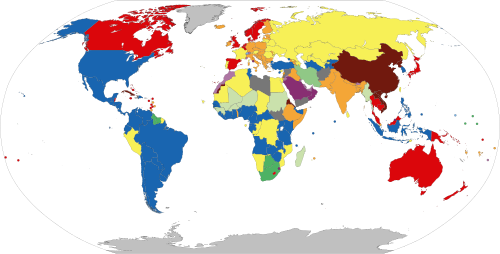
-
Parliamentary systems: Head of government is elected or nominated by and accountable to the legislature.Constitutional monarchy with a ceremonial monarchParliamentary republic with a ceremonial presidentParliamentary republic with an executive president
Presidential system: Head of government (president) is popularly elected and independent of the legislature.Presidential republic
Hybrid systems:Semi-presidential republic: Executive president is independent of the legislature; head of government is appointed by the president and is accountable to the legislature.Assembly-independent republic: Head of government (president or directory) is elected by the legislature, but is not accountable to it.
Other systems:Theocratic republic: Supreme leader is head of both the state and the faith, and holds significant executive and legislative powerSemi-constitutional monarchy: Monarch holds significant executive or legislative power but is still restricted by the constitution.Absolute monarchy: Monarch has unlimited power.One-party state: Power is constitutionally linked to a single political party.Military junta: Committee of military leaders controls the government; constitutional provisions are suspended.Governments with no constitutional basis: No constitutionally defined basis to current regime, i.e., provisional governments or Islamic theocracies.Dependent territories or places without governments
Note: this chart represents the de jure systems of government, not the de facto degree of democracy.
This head of government is often also the head of state. In a presidential system, the head of government is directly or indirectly elected by a group of citizens and is not responsible to the legislature, and the legislature cannot dismiss the president except in extraordinary cases. A presidential system contrasts with a parliamentary system, where the head of government (usually called a prime minister) derives their power from the confidence of an elected legislature, which can dismiss the prime minister with an ordinary majority.
Not all presidential systems use the title of president. Likewise, the title is sometimes used by other systems. It originated from a time when such a person personally presided over the governing body, as with the president of the Continental Congress in the early United States, before the executive function being split into a separate branch of government. Presidents may also use it in semi-presidential systems. Heads of state of parliamentary republics, largely ceremonial in most cases, are called presidents. Dictators or leaders of one-party states, whether popularly elected or not, are also often called presidents.
The presidential system is the most common form of government in the Americas and is also frequently found in Sub-Saharan Africa (along with semi-presidential hybrid systems). By contrast, there are very few presidential republics in Europe (with Cyprus and Turkey being the only examples). In Asia, the system is used by South Korea, Syria, the Philippines, and Indonesia.
History
Development in the Americas
The presidential system has its roots in the governance of the British colonies of the 17th century in what is now the United States. The Pilgrims, permitted to govern themselves in Plymouth Colony, established a system that utilized an independent executive branch. Each year, a governor was chosen by the colonial legislature, as well as several assistants, analogous to modern-day cabinets. Additional executive officials such as constables and messengers were then appointed. At the same time, the British Isles underwent a brief period of republicanism as the Protectorate, during which the Lord Protector served as an executive leader similar to a president.
The first true presidential system was developed during the United States Constitutional Convention in 1787. Drawing inspiration from the previous colonial governments, from English Common Law, and from philosophers such as John Locke and Montesquieu, the delegates developed what is now known as the presidential system. Most notably, James Wilson advocated for a unitary executive figure that would become the role of the president. The United States became the first presidential republic when the Constitution of the United States came into force in 1789, and George Washington became the first president under a presidential system.
During the 1810s and 1820s, Spanish colonies in the Americas sought independence, and several new Spanish-speaking governments emerged in Latin America. These countries modeled their constitutions after that of the United States, and the presidential system became the dominant political system in the Americas. Following several decades of monarchy, Brazil also adopted the presidential system in 1889 with Deodoro da Fonseca as its first president. Latin American presidential systems have experienced varying levels of stability, with many experiencing periods of dictatorial rule.
As a global system
Following the pattern of other Spanish colonies, the Philippines established the first presidential system in Asia in 1898, but it fell under American control due to the Spanish–American War. The presidential system was restored after the United States granted the Philippines independence in 1946.
The end of World War II established presidential systems in two countries. After the United States ended the Japanese occupation of Korea, it assisted South Korea in the formation of a presidential government. However, the early years of the South Korean presidency were marked by dictatorial control. At the same time, Indonesia declared independence from the Netherlands in 1945. While it nominally used a presidential system, it was in effect a dictatorship where the president controlled all branches of government. A democratic presidential system was established in Indonesia in 1998 and in Korea in 1987.
Decolonization in the 1950s and 1960s brought with it a significant expansion of the presidential system. During this time, several new presidential republics were formed in Africa.[citation needed] Cyprus, the Maldives, and South Vietnam also adopted the presidential system following decolonization. Pakistan and Bangladesh did so as well, but they changed their governmental systems shortly afterwards.
Several more countries adopted the presidential system in the final decades of the 20th century. A modified version of the presidential system was implemented in Iran following constitutional reform in 1989, in which the Supreme Leader serves as the head of state and is the absolute power in this country. In 1981, Palau achieved independence and adopted a presidential system. When the Soviet Union was dissolved in 1991, the presidential system was adopted by the new states that were created, though most of them adopted other governmental systems over the following decades.
The presidential system continues to be adopted in the 21st century. Following its independence in 2011, South Sudan adopted a presidential system. In 2018, after the 2017 Turkish constitutional referendum, Turkey adopted a presidential system. In 2025, following the adoption of the Constitutional Declaration, Syria established a presidential system.
Features
Several characteristics are unique to presidential systems or prominent in countries that use presidential systems. The defining aspect of presidential systems is the separation of powers that divides the executive and the legislature. Advocates of presidential systems cite the democratic nature of presidential elections, the advantages of the separation of powers, the efficiency of a unitary executive, and the stability provided by fixed terms. Opponents of presidential systems cite the potential for gridlock, the difficulty of changing leadership, and concerns that a unitary executive can give way to a dictatorship.
Separation of powers
The presidential system is defined by the separation of the executive branch from other aspects of government. The head of government is elected to work alongside, but not as a part of, the legislature. There are several types of powers that are traditionally delegated to the president. Under a presidential system, the president may have the power to challenge legislation through a veto, the power to pardon crimes, authority over foreign policy, authority to command the military as the Commander-in-chief, and authority over advisors and employees of the executive branch.[citation needed]
Checks and balances
Separation of powers is sometimes held up as an advantage, in that each branch may scrutinize the actions of the other. This is in contrast with a parliamentary system, where the majority party in the legislature that also serves as the executive is unlikely to scrutinize its actions. Writing about the Watergate scandal, former British MP Woodrow Wyatt said, "Don't think a Watergate couldn't happen here, you just wouldn't hear about it." The extent of this effect is debated. Some commentators argue that the effect is mitigated when the president's party is in power, while others note that party discipline is not as strictly enforced in presidential systems.
James Wilson's theories

James Wilson, who advocated for a presidential system at the constitutional convention, maintained that a single chief executive would provide for greater public accountability than a group and thereby protect against tyranny by making it plain who was responsible for executive actions. He also submitted that a singular chief executive was necessary to ensure promptness and consistency and guard against deadlock, which could be essential in times of national emergency.
Presidential systems are largely able to avoid cabinet crises, due to a unitary executive being solely responsible for running the government. This was highlighted by James Wilson, who is quoted below.
The executive as well as the legislative power ought to be restrained. ... The restraints on the legislative authority, must from its nature, be chiefly internal; that is, they must proceed from some part or division of itself. But the restraints on the executive power are external. These restraints are applied with the greatest certainty, and with greatest efficacy, when the object of restraint is clearly ascertained. This is best done, when one object only, distinguished and responsible, is conspicuously held up to the view and examination of the publick [sic]. . . . In planning, forming and arranging laws, deliberation is always becoming, and always useful. But in the active scenes of government, there are emergencies, in which the man, as, in other cases, the women [sic], who deliberates is lost. Secrecy may be equally necessary as dispatch. But, can either secrecy or dispatch be expected, when, to every enterprise, mutual communication, mutual consultation, and mutual agreement among men, perhaps of discordant views, of discordant tempers, and of discordant interests, are indispensably necessary? How much time will be consumed! and when it is consumed, how little business will be done! When the time is elapsed; when the business is finished; when the state is in distress, perhaps on the verge of destruction; on whom shall we fix the blame? Whom shall we select as the object of punishment?
— James Wilson
Efficiencies and inefficiencies
When an action is within the scope of a president's power, a presidential system can respond more rapidly to emerging situations than a parliamentary system. A prime minister, when taking action, needs to retain the support of the legislature, but a president is often less constrained. In Why England Slept, future U.S. president John F. Kennedy argued that British prime ministers Stanley Baldwin and Neville Chamberlain were constrained by the need to maintain the confidence of the Commons. It is easy for either the president or the legislature to escape blame by shifting it to the other. Describing the United States, former treasury secretary C. Douglas Dillon said, "The president blames Congress, the Congress blames the president, and the public remains confused and disgusted with the government in Washington". Years before becoming president, Woodrow Wilson famously wrote "how is the schoolmaster, the nation, to know which boy needs the whipping?" Walter Bagehot said of the American system, "The executive is crippled by not getting the law it needs, and the legislature is spoiled by having to act without responsibility: the executive becomes unfit for its name since it cannot execute what it decides on; the legislature is demoralized by liberty, by taking decisions of which others [and not itself] will suffer the effects".
Conversely, a presidential system can produce gridlock when the president and the legislature are in opposition. This rarely happens in a parliamentary system, as the prime minister is always a member of the party in power. This gridlock is a common occurrence, as the electorate often expects more rapid results than are possible from new policies and switches to a different party at the next election. Critics such as Juan Linz, argue that in such cases of gridlock, presidential systems do not offer voters the kind of accountability seen in parliamentary systems and that this inherent political instability can cause democracies to fail, as seen in such cases as Brazil and Allende's Chile.
A 2024 meta-analytical review found that presidential systems were associated with more corruption than parliamentary systems.
Continuity and Crisis Response
The structure of the political system can affect how quickly the government responds to national emergencies like economic collapse, terrorism, natural disasters, and so forth. The presidential system's structure enables it to respond more quickly and steadily than the parliamentary system, particularly in emergency situations, according to proponents of presidentialism. A fixed executive term, the division of powers among the departments, the concentration of decision-making authority, and ongoing leadership are all characteristics of the presidential system.
Presidential elections
In a presidential system, the president is elected independently of the legislature. This may be done directly through a popular vote or indirectly, such as through the electoral college used in the United States. This aspect of the presidential system is sometimes touted as more democratic, as it provides a broader mandate for the president. Once elected, a president typically remains in office until the conclusion of a term.
Fixed-terms
Presidential systems are typically understood as having a head of government elected by citizens to serve one or more fixed terms. Fixed terms are praised for providing a level of stability that other systems lack.[citation needed]
Proponents[who?] of the presidential system also argue that stability extends to the cabinets chosen under the system. In most parliamentary systems, the prime minister has no free hand in assembling their cabinet: Westminster type-systems have electoral systems which usually result in single-party majority governments, but their cabinets must be drawn from within the legislative branch; while in the continental European model, ministers can be appointed from outside the legislature but the electoral system usually results in the formation of multi-party coalition governments. Under the presidential system, presidents have a free hand in selecting cabinet members based as much or more on their ability and competency to lead a particular department as on their loyalty to the president or the president's supports in the legislature, as opposed to parliamentary cabinets, which might be filled by ministers chosen for no better reason than their perceived loyalty to the prime minister or the demands of junior coalition partners.[citation needed]
Some political scientists dispute this concept of stability, arguing that presidential systems have difficulty sustaining democratic practices and that they have slipped into authoritarianism in many of the countries in which they have been implemented; in other words, the lack of constraints on cabinet formation actually enables the president to select a cabinet of loyalists. According to political scientist Fred Riggs, presidential systems have fallen into authoritarianism in nearly every country where they've been attempted. The list of the world's 22 older democracies includes only two countries (Costa Rica and the United States) with presidential systems. Yale political scientist Juan Linz argues that:
The danger that zero-sum presidential elections pose is compounded by the rigidity of the president's fixed term in office. Winners and losers are sharply defined for the entire period of the presidential mandate. Losers must wait four or five years without any access to executive power and patronage. The zero-sum game in presidential regimes raises the stakes of presidential elections and inevitably exacerbates their attendant tension and polarization.
Fixed terms in a presidential system may also be considered a check on the powers of the executive, contrasting with parliamentary systems, which may allow the prime minister to call elections whenever they see fit or orchestrate a vote of no confidence to trigger an election when they cannot get a legislative item passed.
Limited mechanisms of removal
Unlike in parliamentary systems, the legislature does not have the power to recall a president under the presidential system. However, presidential systems may have methods to remove presidents under extraordinary circumstances, such as a president committing a crime or becoming incapacitated. In some countries, presidents are subject to term limits.
The inability to remove a president early is also the subject of criticism. Even if a president is "proved to be inefficient, even if he becomes unpopular, even if his policy is unacceptable to the majority of his countrymen, he and his methods must be endured until the moment comes for a new election".
The consistency of a presidency may be seen as beneficial during times of crisis. When in a time of crisis, countries may be better off being led by a president with a fixed term than rotating premierships.[citation needed] Some critics, however, argue that the presidential system is weaker because it does not allow a transfer of power in the event of an emergency. Walter Bagehot argues that the ideal ruler in times of calm is different from the ideal ruler in times of crisis, criticizing the presidential system for having no mechanism to make such a change.
Heightened status
The president's status as both head of government and head of state is sometimes the subject of criticism. Dana D. Nelson criticizes the office of the President of the United States as essentially undemocratic and characterizes presidentialism as worship of the president by citizens, which she believes undermines civic participation.
Political budget cycles
A 2019 peer-reviewed meta-analysis based on 1,037 regressions in 46 studies finds that presidential systems generally seem to favor revenue cuts, while parliamentary systems would rely on fiscal expansion characterized by a higher level of spending before an election.
Paradoxes
Presidentialism is often criticized for its inherent contradictions and electoral dynamics. Scholars highlight the paradox of simultaneously empowering and constraining presidents, creating tension in governance. Additionally, the winner-take-all nature of presidential elections fosters zero-sum competition, intensifying polarization and conflict. Together, these features illustrate the structural challenges of presidential systems.
Scholars of comparative politics often note that presidential systems embody inherent contradictions. These constitutions are designed to produce a strong and stable executive, often legitimized through direct popular election. The president is expected to stand above the particular interests represented in legislatures and to articulate a unified “will of the people.” This Rousseauian notion contrasts with the Anglo-American tradition, which views democracy as the competition and negotiation of diverse interests. In practice, the effort to centralize representation in the office of the president may displace conflict into extra-political arenas rather than eliminating it.
At the same time, presidential constitutions also reflect deep suspicion toward the personalization of power. Memories of monarchs and authoritarian rulers influenced provisions that restrict executive authority. Common safeguards include bans on reelection, legislative advice-and-consent powers over appointments, impeachment procedures, guarantees of judicial independence, and oversight institutions such as Chile’s Contraloría. In some contexts, even the intervention of the armed forces has historically been regarded as a moderating influence against executive overreach.
This paradox—the simultaneous empowerment and constraint of the presidency—shapes decision-making, leadership style, and political rhetoric. It also introduces a dimension of tension not reducible to socioeconomic or ideological factors. In Latin America, for instance, constitutions intended to prevent personalist leadership sometimes reinforce personalismo by concentrating symbolic legitimacy in a single office. The resulting contradiction between constitutional texts and political practice has been widely observed in the region’s history.
Compared with parliamentary systems, presidentialism tends to create rigidity in the political process. Supporters argue that this rigidity ensures predictability by shielding executives from frequent parliamentary realignments or votes of no confidence. However, unforeseen developments—such as the death of an incumbent or serious misjudgments during crises—can leave presidential systems weaker and less adaptable than parliamentary governments. Prime ministers may restore legitimacy through confidence votes or early elections, and leadership changes do not necessarily trigger regime crises. By contrast, replacing a president often produces institutional deadlock or political instability.
These structural paradoxes are especially significant during regime transitions and democratic consolidation. While presidentialism promises authority and stability, its rigid frameworks can reduce flexibility in times of uncertainty. The tension between empowering executives and restraining them remains a defining feature of presidential constitutions, shaping both their strengths and vulnerabilities.
Zero-sum election
A common criticism of presidentialism is the zero-sum character of presidential elections. Because the president is elected through a winner-take-all contest, political competition often becomes highly polarized, with victory granting one side exclusive control of executive authority. This arrangement can turn democratic politics into a zero-sum game, heightening the potential for conflict.
By contrast, parliamentary elections more often distribute representation among multiple parties. Coalition-building and power-sharing are common, leading incumbents to accommodate the demands of smaller parties and ensuring that those parties retain a stake in the system. Such arrangements reduce polarization and enhance democratic stability.
Presidents, however, frequently interpret their authority as an independent popular mandate, even when elected by a narrow plurality. This perception fosters a sense of unilateral mission, making opposition to presidential policies appear more irksome than in parliamentary systems. Prime ministers, acting as representatives of temporary governing coalitions, are generally more accustomed to compromise.
In some contexts, presidential regimes have sought to mitigate the harsh implications of winner-take-all elections through informal consociational agreements. In Venezuela and Colombia, for example, presidential constitutions remained in place, but major parties turned to negotiated power-sharing to stabilize democracy. These practices illustrate both the adaptability of presidential regimes and the institutional challenges posed by their zero-sum nature.
The Spanish example
The 1977 general election in Spain marked the country’s first free democratic vote following the death of dictator Francisco Franco. Acting Prime Minister Adolfo Suárez, leader of the centrist Unión de Centro Democrático (UCD), secured 34.9% of the vote and 167 of 350 parliamentary seats, remaining in office. The Spanish Socialist Workers’ Party (PSOE), led by Felipe González, won 29.4% and 118 seats, while the Communist Party (PCE) gained 9.3% and 20 seats, and the right-wing Alianza Popular (AP), under Manuel Fraga, took 8.4% and 16 seats.
Analysts have since argued that if Spain had held a presidential election instead of a parliamentary one, the results would likely have been far more divisive. No single party commanded a majority, meaning any presidential candidate would have needed to form broad and uncertain coalitions. Given the lack of clear information about voter preferences and the fragmented nature of Spain’s political spectrum at the time, coalition-building would have been both risky and unstable.
For the left, a unified campaign around Felipe González might have seemed possible, but it would have required alliances with Communists and regional nationalist parties, undermining the PSOE’s independent identity. Such a “popular front” strategy could have produced ideological confusion and alienated centrist voters.
On the right, Suárez’s centrist UCD faced similar dilemmas. While Suárez represented moderate reformers who had negotiated Spain’s peaceful transition, the AP was widely viewed as the continuist heir of the Franco regime. A right-wing alliance risked associating Suárez with authoritarian remnants, while refusal to cooperate with Fraga’s AP might have split the conservative vote.
In a hypothetical presidential race, campaigning would likely have intensified polarization between the democratic left and the post-Franco right. Each side would have framed the other as a threat—either “communist radicals” or “Franco’s heirs.” The resulting confrontation might have derailed the fragile process of democratic consolidation.
Ultimately, Spain’s adoption of a parliamentary framework helped moderate its political transition. Parliamentarism enabled distinct parties to coexist, negotiate, and evolve without forcing premature ideological fusion. The success of Spain’s democratization from 1977 onward—culminating in González’s stable Socialist government in 1982—illustrates how parliamentary institutions encouraged gradual reform, compromise, and national unity.
In short, the Spanish case suggests that during democratic transitions, parliamentary systems tend to mitigate polarization, while presidential contests can magnify it.
Comparative politics
The separation of the executive and the legislature is the key difference between a presidential system and a parliamentary system. The presidential system elects a head of government independently of the legislature, while in contrast, the head of government in a parliamentary system answers directly to the legislature. Presidential systems necessarily operate under the principle of structural separation of powers, while parliamentary systems do not; however, the degree of functional separation of powers exhibited in each varies – dualistic parliamentary systems such as the Netherlands, Sweden and Slovakia forbid members of the legislature from serving in the executive simultaneously, while Westminster-type parliamentary systems such as the United Kingdom require it. Heads of government under the presidential system do not depend on the approval of the legislature as they do in a parliamentary system (except for mechanisms such as impeachment).
The presidential system and the parliamentary system can also be blended into a semi-presidential system. Under such a system, executive power is shared by an elected head of state (a president) and a legislature-appointed head of government (a prime minister or premier). The amount of power each figure holds may vary, and a semi-presidential system may lean closer to one system over the other. The president typically retains authority over foreign policy in a semi-presidential system.[citation needed] A pure presidential system may also have mechanisms that resemble those of a parliamentary system as part of checks and balances. The legislature may have oversight of some of the president's decisions through advice and consent, and mechanisms such as impeachment may allow the legislature to remove the president under drastic circumstances.[citation needed]
Presidentialism metrics
Presidentialism metrics allow a quantitative comparison of the strength of presidential system characteristics for individual countries. Presidentialism metrics include the presidential index in V-Dem Democracy indices and presidential power scores. The table below shows for individual countries the V-Dem presidential index, where higher values indicate higher concentration of political power in the hands of one individual, such as the general secretary of the Communist Party in one-party ruling communist states.
| Country | Presidentialism Index for 2021 |
|---|---|
 Afghanistan Afghanistan | 0.934 |
 Albania Albania | 0.22 |
 Algeria Algeria | 0.807 |
 Angola Angola | 0.627 |
 Argentina Argentina | 0.203 |
 Armenia Armenia | 0.297 |
 Australia Australia | 0.01 |
 Austria Austria | 0.047 |
 Azerbaijan Azerbaijan | 0.965 |
 Bahrain Bahrain | 0.917 |
 Bangladesh Bangladesh | 0.711 |
 Barbados Barbados | 0.091 |
 Belarus Belarus | 0.98 |
 Belgium Belgium | 0.051 |
 Benin Benin | 0.419 |
 Bhutan Bhutan | 0.117 |
 Bolivia Bolivia | 0.535 |
 Bosnia and Herzegovina Bosnia and Herzegovina | 0.327 |
 Botswana Botswana | 0.176 |
 Brazil Brazil | 0.136 |
 Bulgaria Bulgaria | 0.16 |
 Burkina Faso Burkina Faso | 0.314 |
 Myanmar Myanmar | 0.879 |
 Burundi Burundi | 0.801 |
 Cambodia Cambodia | 0.88 |
 Cameroon Cameroon | 0.873 |
 Canada Canada | 0.08 |
 Cape Verde Cape Verde | 0.098 |
 Central African Republic Central African Republic | 0.618 |
 Chad Chad | 0.929 |
 Chile Chile | 0.019 |
 China China | 0.891 |
 Colombia Colombia | 0.133 |
 Comoros Comoros | 0.833 |
 Costa Rica Costa Rica | 0.033 |
 Croatia Croatia | 0.107 |
 Cuba Cuba | 0.806 |
 Cyprus Cyprus | 0.151 |
 Czech Republic Czech Republic | 0.09 |
 Democratic Republic of the Congo Democratic Republic of the Congo | 0.689 |
 Denmark Denmark | 0.012 |
 Djibouti Djibouti | 0.751 |
 Dominican Republic Dominican Republic | 0.181 |
 Ecuador Ecuador | 0.397 |
 Egypt Egypt | 0.494 |
 El Salvador El Salvador | 0.855 |
 Equatorial Guinea Equatorial Guinea | 0.966 |
 Eritrea Eritrea | 0.977 |
 Estonia Estonia | 0.033 |
 Eswatini Eswatini | 0.707 |
 Ethiopia Ethiopia | 0.735 |
 Fiji Fiji | 0.525 |
 Finland Finland | 0.022 |
 France France | 0.068 |
 Gabon Gabon | 0.752 |
 Georgia Georgia | 0.282 |
 Germany Germany | 0.033 |
 Ghana Ghana | 0.13 |
 Greece Greece | 0.12 |
 Guatemala Guatemala | 0.351 |
 Guinea Guinea | 0.764 |
 Guinea-Bissau Guinea-Bissau | 0.413 |
 Guyana Guyana | 0.276 |
 Haiti Haiti | 0.706 |
 Honduras Honduras | 0.402 |
 Hong Kong Hong Kong | 0.569 |
 Hungary Hungary | 0.288 |
 Iceland Iceland | 0.051 |
 India India | 0.227 |
 Indonesia Indonesia | 0.206 |
 Iran Iran | 0.812 |
 Iraq Iraq | 0.484 |
 Ireland Ireland | 0.04 |
 Israel Israel | 0.1 |
 Italy Italy | 0.089 |
 Ivory Coast Ivory Coast | 0.532 |
 Jamaica Jamaica | 0.084 |
 Japan Japan | 0.135 |
 Jordan Jordan | 0.25 |
 Kazakhstan Kazakhstan | 0.807 |
 Kenya Kenya | 0.132 |
 Kosovo Kosovo | 0.296 |
 Kuwait Kuwait | 0.317 |
 Kyrgyzstan Kyrgyzstan | 0.614 |
 Laos Laos | 0.59 |
 Latvia Latvia | 0.036 |
 Lebanon Lebanon | 0.539 |
 Lesotho Lesotho | 0.123 |
 Liberia Liberia | 0.296 |
 Libya Libya | 0.479 |
 Lithuania Lithuania | 0.025 |
 Luxembourg Luxembourg | 0.092 |
 Madagascar Madagascar | 0.677 |
 Malawi Malawi | 0.136 |
 Malaysia Malaysia | 0.354 |
 Maldives Maldives | 0.211 |
 Mali Mali | 0.623 |
 Malta Malta | 0.131 |
 Mauritania Mauritania | 0.74 |
 Mauritius Mauritius | 0.194 |
 Mexico Mexico | 0.369 |
 Moldova Moldova | 0.122 |
 Mongolia Mongolia | 0.207 |
 Montenegro Montenegro | 0.246 |
 Morocco Morocco | 0.348 |
 Mozambique Mozambique | 0.442 |
 Namibia Namibia | 0.207 |
 Nepal Nepal | 0.213 |
 Netherlands Netherlands | 0.028 |
 New Zealand New Zealand | 0.016 |
 Nicaragua Nicaragua | 0.987 |
 Niger Niger | 0.32 |
 Nigeria Nigeria | 0.36 |
 North Korea North Korea | 0.986 |
 North Macedonia North Macedonia | 0.46 |
 Norway Norway | 0.015 |
 Oman Oman | 0.574 |
 Pakistan Pakistan | 0.286 |
 Palestine (Gaza) Palestine (Gaza) | 0.807 |
| Palestine (West Bank) | 0.585 |
 Panama Panama | 0.297 |
 Papua New Guinea Papua New Guinea | 0.197 |
 Paraguay Paraguay | 0.258 |
 Peru Peru | 0.094 |
 Philippines Philippines | 0.35 |
 Poland Poland | 0.361 |
 Portugal Portugal | 0.056 |
 Qatar Qatar | 0.716 |
 Republic of the Congo Republic of the Congo | 0.779 |
 Romania Romania | 0.184 |
 Russia Russia | 0.898 |
 Rwanda Rwanda | 0.738 |
 Sao Tome and Principe Sao Tome and Principe | 0.213 |
 Saudi Arabia Saudi Arabia | 0.814 |
 Senegal Senegal | 0.236 |
 Serbia Serbia | 0.404 |
 Seychelles Seychelles | 0.055 |
 Sierra Leone Sierra Leone | 0.296 |
 Singapore Singapore | 0.298 |
 Slovakia Slovakia | 0.047 |
 Slovenia Slovenia | 0.159 |
 Solomon Islands Solomon Islands | 0.216 |
 Somalia Somalia | 0.756 |
 Somaliland Somaliland | 0.599 |
 South Africa South Africa | 0.13 |
 South Korea South Korea | 0.076 |
 South Sudan South Sudan | 0.881 |
 Spain Spain | 0.031 |
 Sri Lanka Sri Lanka | 0.252 |
 Sudan Sudan | 0.692 |
 Suriname Suriname | 0.126 |
 Sweden Sweden | 0.02 |
 Switzerland Switzerland | 0.013 |
 Syria Syria | 0.922 |
 Taiwan Taiwan | 0.15 |
 Tajikistan Tajikistan | 0.943 |
 Tanzania Tanzania | 0.15 |
 Thailand Thailand | 0.419 |
 The Gambia The Gambia | 0.131 |
 Timor-Leste Timor-Leste | 0.29 |
 Togo Togo | 0.804 |
 Trinidad and Tobago Trinidad and Tobago | 0.113 |
 Tunisia Tunisia | 0.113 |
 Turkey Turkey | 0.722 |
 Turkmenistan Turkmenistan | 0.907 |
 Uganda Uganda | 0.411 |
 Ukraine Ukraine | 0.597 |
 United Arab Emirates United Arab Emirates | 0.835 |
 United Kingdom United Kingdom | 0.062 |
 United States of America United States of America | 0.078 |
 Uruguay Uruguay | 0.045 |
 Uzbekistan Uzbekistan | 0.905 |
 Vanuatu Vanuatu | 0.102 |
 Venezuela Venezuela | 0.958 |
 Vietnam Vietnam | 0.726 |
 Yemen Yemen | 0.884 |
 Zambia Zambia | 0.277 |
 Zanzibar Zanzibar | 0.591 |
 Zimbabwe Zimbabwe | 0.592 |
Subnational governments
Subnational governments may be structured as presidential systems. All of the state governments in the United States use the presidential system, even though this is not constitutionally required. In these cases, instead of the title of President, the role has the title of Governor. On a local level, a presidential system might be organized with the office of the Mayor acting as the president. Some countries without a presidential system at the national level use a form of this system at a subnational or local level. One example is Japan, where the national government uses the parliamentary system.
States with a presidential system of government
Presidential republics without a prime minister
- Angola
- Argentina
- Benin
- Bolivia
- Brazil
- Chile
- Colombia
- Comoros
- Costa Rica
- Cyprus
- Dominican Republic
- Ecuador
- El Salvador
- Gabon
- The Gambia
- Ghana
- Guatemala
- Honduras
- Indonesia
- Liberia
- Malawi
- Maldives
- Mexico
- Nicaragua
- Nigeria
 Palau
Palau- Panama
- Paraguay
- Philippines
- Seychelles
- Somaliland
- Syria
- Turkey
- Turkmenistan
- United States
- Uruguay
- Venezuela
- Zambia
- Zimbabwe
Non-UN members or observers are in italics.
Presidential republics with a prime minister
The following countries have presidential systems where the post of prime minister (official title may vary) exists alongside that of the president. The president is still both the head of state and government and the prime minister's role is to mostly assist the president.
 Abkhazia
- Burundi
- Cameroon
- Central African Republic
- Djibouti
- Equatorial Guinea
- Guinea
- Ivory Coast
- Kenya (see Prime Cabinet Secretary)
- Kyrgyzstan
- Senegal
- Sierra Leone (see Chief minister)
- South Korea
- Tajikistan
- Tanzania
- Tunisia
- Uganda
Non-UN members or observers are in italics.
Presidential system in administrative divisions
Dependencies of the United States
 American Samoa
 Guam
Guam Northern Mariana Islands
 Puerto Rico
 United States Virgin Islands
Special administrative regions of China
- Hong Kong
 Macau
Macau
Former presidential republics
 Islamic Republic of Afghanistan (2004–2021)
- Armenia (1998–2013)
 Azerbaijan SSR/
 Azerbaijan (1990–1991, 1992–2016)
 Cuba (1902–1959)
- Estonia (1938–1940)
 Georgia (1995–2004)
 Germany (1930–1933) de facto[failed verification]
- Greece (1822–1832, 1973–1974)
- Haiti (1859–1957, 1957–1986)
 Katanga (1960–1963)
 Kirghiz SSR/
 Kyrgyzstan (1990–1993)
- Mali (1960–1992)
- Mauritania (1960–1978)
- Niger (1960–1974, 1989–1993)
- Pakistan (1958–1973, 1978–1985, 2001–2002)
 Poland (1935–1939)
- RSFSR/ Russia (1991–1992) de facto
 South Korea (1963–1972)
 South Vietnam (1955–1975)[citation needed]
- Syria (1963–2024)
- Tajik SSR (1990–1991)
- Texas (1836–1845)
- Togo (1960–2024)
- Turkmen SSR (1990–1991)
- Ukraine (1995–1996)
- Uzbek SSR (1990–1991)
Republics with executive governors
- Vermont Republic (1777–1791)
- United Provinces of the Río de la Plata (1820–1832) and Argentine Confederation (1835–1852)
- Alabama (1861–1865)
- Georgia (1861–1865)
- Louisiana (1861–1865)
- Texas (1861–1865)
- Mississippi (1861–1865)
- South Carolina (1861–1865)
- Florida (1861–1865)
- Virginia (1861–1865)
- Arkansas (1861–1865)
- North Carolina (1861–1865)
- Tennessee (1861–1865)
- Missouri (1861–1865)
- Kentucky (1861–1865)
wikipedia, wiki, encyclopedia, book, article, read, free download, Information about presidential system. What is presidential system? What does presidential system mean?